Myanmar – Our Trip in a Photo Essay (Mostly)

Myanmar is a magical country.  Full of things that you can’t believe that you just saw or that even exist.  The skies were always a deep blue with gentle (and thankfully harmless) puffy clouds.  They provided a marvelous back drop to many of our photos.

So, yes.  Go now.  Run, Don’t Walk.  Go before Myanmar changes, as it will inevitably.  Go before it gets commercialized.  Go before the people change.  Go while it’s still under the radar and shrouded in mystery.

We came during the rainy season, the tourist low season.  Was it a mistake?  Nope.  We experienced the perfect mix of limited foreign tourists while it rained hardly at all.  Magically we got to explore Myanmar as if all by ourselves while we only had part of 2 days washed out.  One during our Habitat for Humanity build and another while travelling around Myanmar.  But even the storms are remarkable.  Big drops of rain accompanies by loud claps of thunder and bright flashes of lightning.

We thought we’d try something a little different with this post.  We’re going to try a photo essay and try to keep the word count down.

For chronology’s sake, we started our trip in Yangon (formerly known as Rangoon).  We then did our Habitat build in Bago from which we visited the Golden Rock Temple.  Yangon is in the south of Myanmar with Bago and the Golden Rock Temple to the north-east, but more east and only a little north.  Once back in Yangon, we began our solo exploration of Myanmar.  We visited three additional cities in Myanmar.  Bagan, Mandalay and Inle Lake/Nyaung U/Taunggyi region.  Picture a diamond with Yangon as the southern point.  Bagan is north-west of Yangon, Mandalay is directly north of Yangon and north-east of Bagan.  Inle Lake/Nyaung U and Taunggyi are to the east of Bagan and to the south-east of Mandalay.  So that’s your diamond.  Mandalay is the farthest north we went but it’s only halfway to the extreme northern end of Myanmar.

There is a semi-autonomous region inside Myanmar called The Shan State.  There is still civil and military unrest in The Shan State and the government has yet to make peace with many of the ethnic groups that make up this area.  Most of the unrest is to the north and east of where we were (there was a train bombing well to the north of Mandalay shortly before we began our independent trip but were assured it was safe), and we felt none of the turmoil.  That said, Taunggyi is the capital of The Shan State and the locals are fiercely proud of their hybrid (independent) situation.

So – let’s being our photo journey and as Neil deGrasse Tyson would say, “Come with us!”

Yangon

The most important thing to see in Yangon and the most important thing to see in all of Myanmar is Shwedagon Pagoda.  The pagoda is said to have either have been built 2600 years ago or more recently in the 12th-16th centuries.  Either way, the pagoda is said to contain 8 hairs from Gautama Buddha and several of his predecessor Buddhas (Buddha is a title, not his name).  The Gautama Buddha we see most often is really the 4th in a succession of 5 Buddhas with the 5th yet to appear.  On our first night in Yangon we went to a rooftop bar and restaurant.  This was our view.
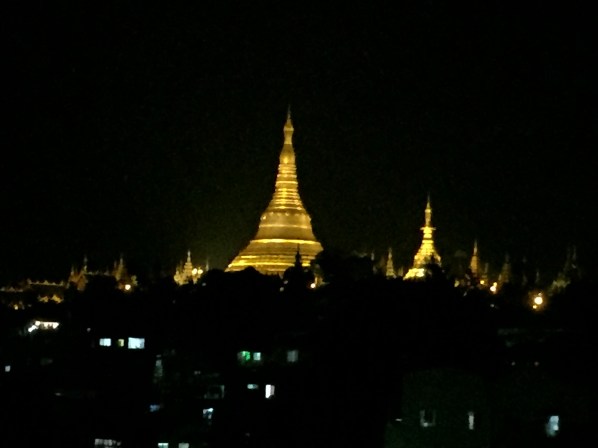
MYR 1

As spectacular as that view was of Shwedagon Pagoda, we went the next night to watch the sunset and saw this:
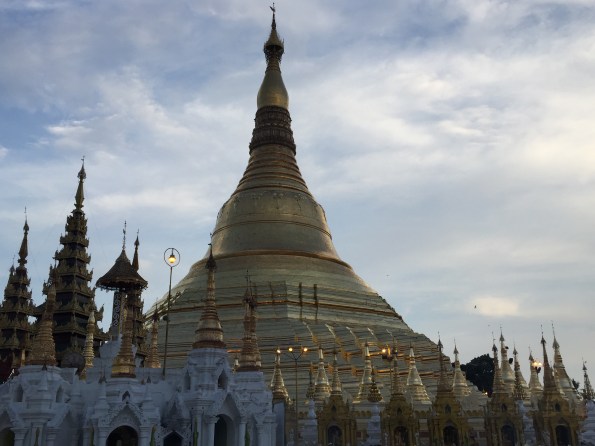
MYR 2

A pagoda or stupa is a domed building with a casket on top of the dome followed by a steeple.  Many temples have a similar shape, but the key difference is that a pagoda or stupa cannot be entered; reverence is shown by walking around the pagoda or kneeling before it.  A temple can be entered for prayer.

As the sun continued its descent, our view changed to this.
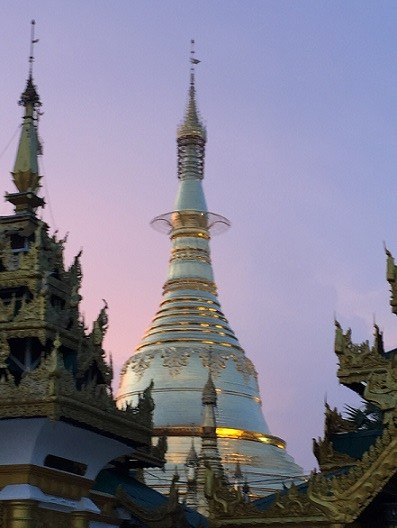
MYR 3

Truly spectacular.  We were very moved by this start to our journey in Myanmar.  Just looking at this photo brings us tremendous joy and peace.  There just aren’t that many things this beautiful that we’ve come across.  It simply has a calming influence.  This is a devoutly spiritual place.  One’s mind and spirit can’t help but take notice.

Bagan

Bagan was founded in the 2nd Century AD according to local legend but was likely built in the 9th Century.  It has been peacefully ruled since and because of this stability has some of the most remarkable pagodas and temples in all of Myanmar.

The first we viewed was Shwezigon Pagoda.

MYR 4

Next we saw Htilominlo Guphaya-Gyi, which was built in the 13th Century.  It’s undergoing renovations but is 150 feet tall and has 3 stories that can be climbed.
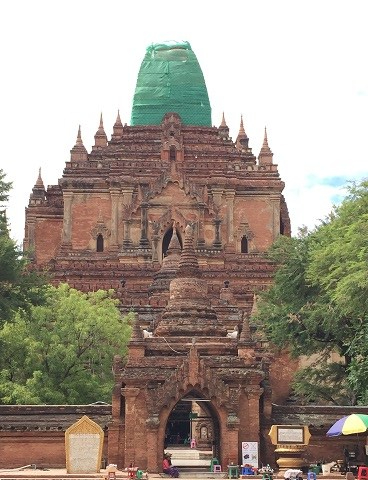
MYR 5

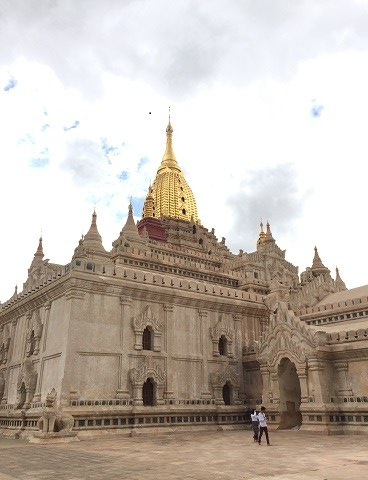
Next we visited Ananda Phaya.  One of the most spectacular temples that we saw.  It has served as the template for a great number of other temples in Myanmar.  The golden dome is just an awesome sight in person, especially with the very powerful sun directly above us.  Built in the very early 12th Century.

MYR 6

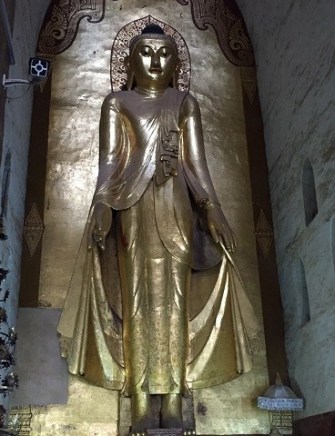
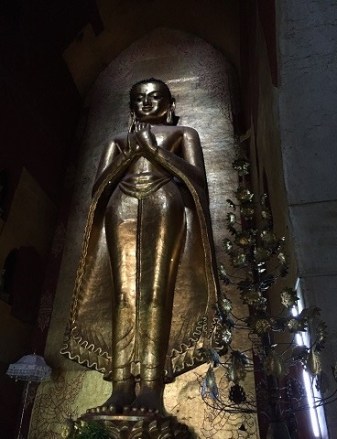
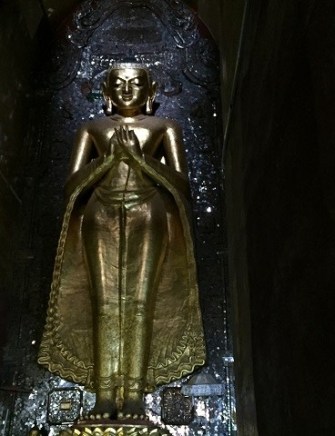
Because it’s a temple, you can walk inside.  The temple has 4 very large Buddha statues facing each of the four cardinal directions.

MYR 7MYR 8

MYR 9MYR 10

One thing to note in these photos.  Each of these 4 photos represents a standing Buddha with a different hand position (actually 2 hand positions are the same, so 3 hand positions).  Each standing or seated position combined with a one handed or two-handed position has a name (called a mudra).  Each evokes a mental state.  Buddhist rules mandate that the Buddha’s eyes be closed and that he have a calm look on his face.  In total there are 28 or 32 or 37 (depending on what your read) mudras.

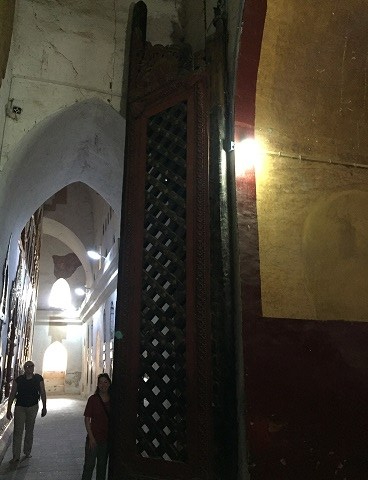
To understand the size of these statues, here is E standing next to a door inside Ananda Phaya.  The bronze statues are taller than the doors.

MYR 11

A different view of the dome atop Ananda Phaya and a bit more of the sideview.

MYR 12

Bupaya

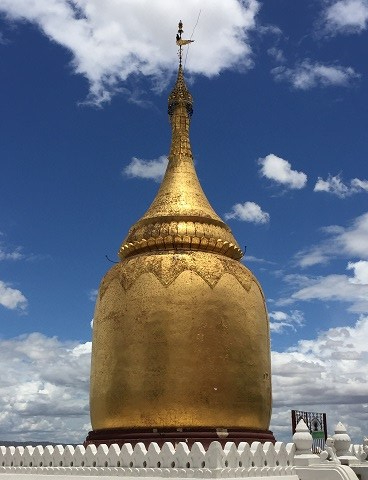
Built in the 3rd Century AD to celebrate the Iriwaddy River on whose banks the stupa is built.  The gold leaf and the dark-blue sky contrast so beautifully.  The picture was taken about noon with the sun almost directly on top of us.  The sun shone so brightly that most of our photos of Bupaya were washed out.  Luckily this one does the trick.  The original was destroyed in a 1975 earthquake and a new statue was commissioned with a more modern design.  While the shape may have changed only slightly, hopefully the gold leaf and the blue sky are true to the original.

MYR 13

Dhammayangyi Temple

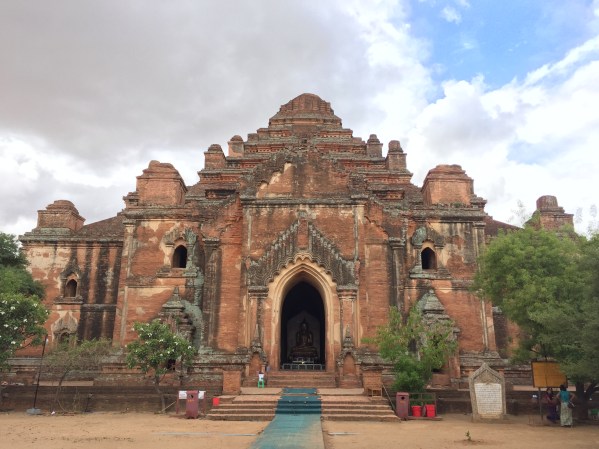
Built in the middle 12th Century, Dhammayangyi was built similarly to Ananda Phaya.  So it also has 4 Buddha statues facing the four cardinal directions.  That said, Dhammayangyi is the largest temple in all of Bagan and it is massive.

MYR 14

Sulamani Guphaya

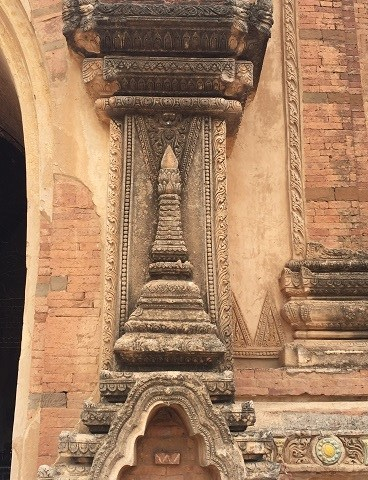
It’s hard to properly capture how beautiful this temple was.  The intricacy of the carving on both the outside and inside coupled with the paintings on the inside are just stunning.  Built in the late 12 Century but still in pretty good shape.

MYR 15

MYR 16

We entered the temple from one of the side entrances to avoid the hawkers, so we’re not look at its best side.  But like many of the temples built of this era, there is a large bronze Buddha statue facing each of the four cardinal directions.
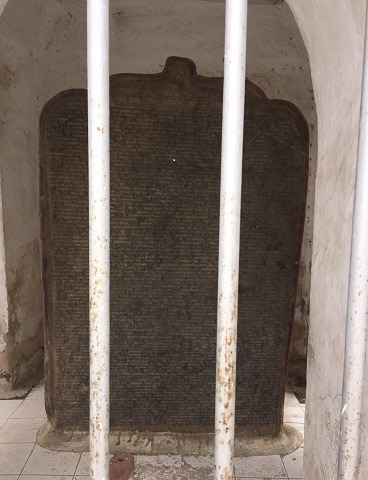
One neat feature of this temple was a stone tablet reflecting the royal order that Sulamani Guphaya be built.
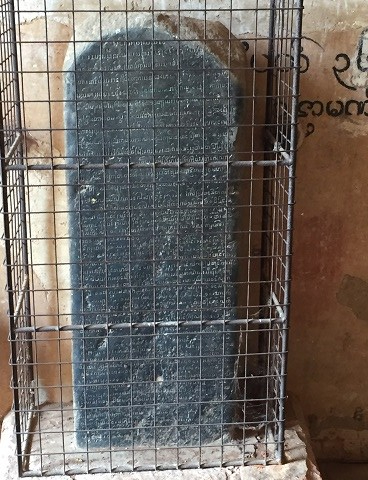
MYR 17

Mandalay

Mandalay is the second largest city in Myanmar and home to the last royal capital.  Mandalay also lies along the Irrawaddy River and is basically a large flood plain.  The defining landmarks of Mandalay are its impressive royal city (complete with rectangular moat), Mandalay Hill and lots of monasteries and temples.

Our first day in Mandalay was a half day and we went to Mandalay Hill to visit a temple and to watch the sunset.  While waiting for sunset, a monk asked to take a photo with us.  He didn’t ask us for anything, but just stood quietly while his friend took our photo.  This happened to us several times in Myanmar, including both with monks and local tourists, but this one felt special.
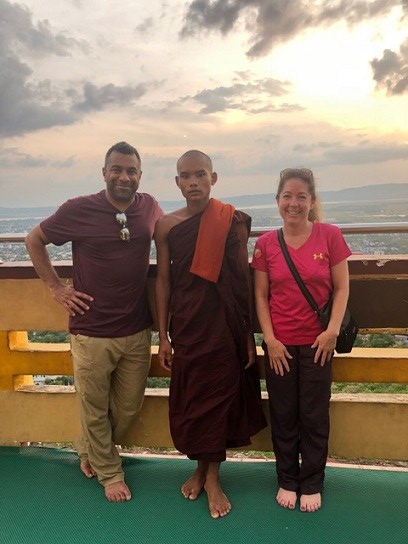
MYR 18

Speaking of the sunset, here it comes…setting over the Irrawaddy River in the background.
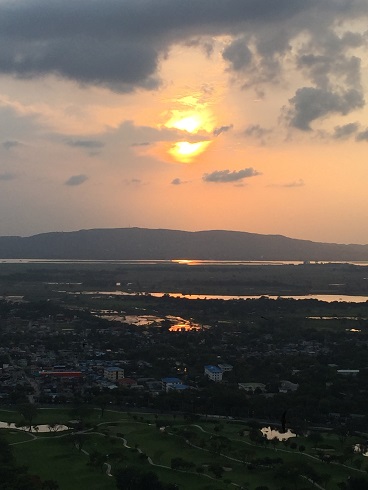
MYR 19

The next day we rented a car with driver and hit the following…

Mahamuni Buddha Temple

This temple is special because it houses a statue dating back to 550 BC.  The Buddha himself blessed the statue as being in his likeness and is said to be only one of 5 likenesses of the Buddha (2 are in heaven and 2 in India).
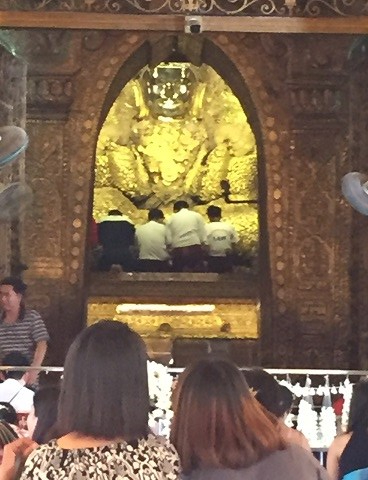
MYR 20

Sorry for the poor photo.  Only men are allowed up front but not their cameras.  The statue itself is covered in gold leaf.  And over 2500 years the gold leaf has accumulated to over 6 inches thick in some places!!

Next, we headed to the Royal Palace of Mandalay, the last royal residence in Myanmar.

The main entrance…
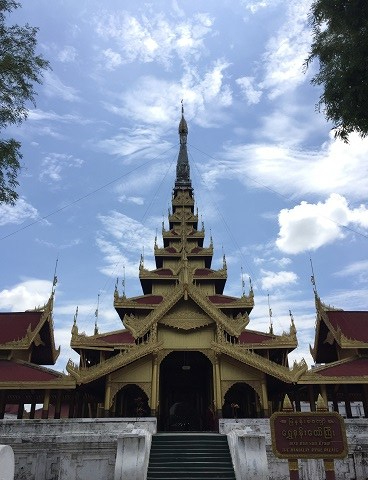
MYR 21

The main palace…

MYR 22

One of the many buildings that make up the royal complex…
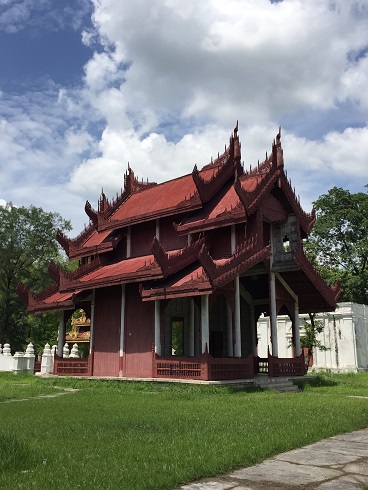
MYR 23

The watch tower…with E in the lower left corner
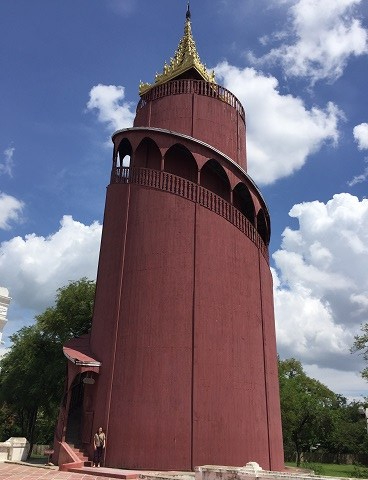
MYR 24

Next, we went to visit Atumashi Monastery.  Not only do monks live and train in monasteries but they’re also places for locals to come pray and where young children often come for early age schooling.

MYR 25

Across the street from Atumashi is Shwenandaw Monastery.

MYR 26

The carving work is simply stunning.  And that’s teak!  Very heavy and dense wood.
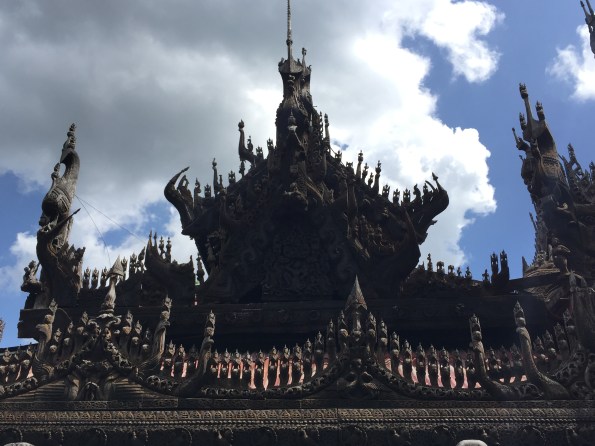
MYR 27

Next we went to Kuthodaw Pagoda.  While the temple and stupa are impressive, the grounds are more impressive.  They are said to hold the world’s largest book.

The main stupa is modeled after Shwezigon in Bagan but there are 730 stone-inscription caves that hold a stone tablet.  On each side of the stone tablet, all the teachings of Theravada Buddhism are inscribed.  So it’s effectively 1460 pages of text.  As such, they are deemed to be the world’s largest book.
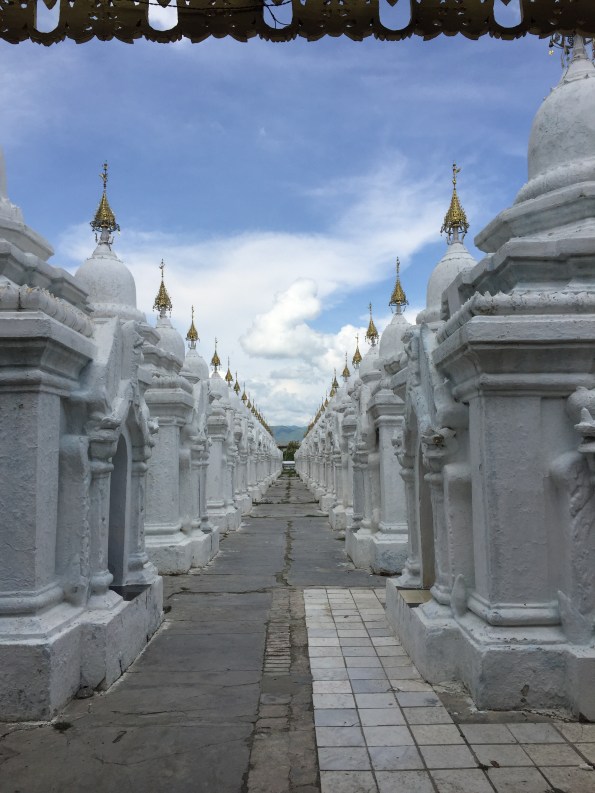
MYR 28

MYR 29

Next we went to Sandamuni Paya, which happened to be around the corner from Kuthodaw.

The main stupa at Sandamuni Paya…
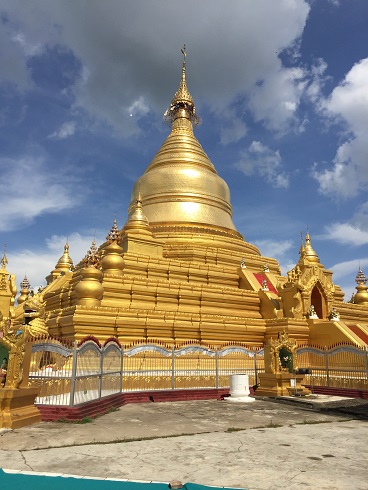
MYR 30

Similar to Kuthodaw, there are 1774 stone-inscription caves holding tablets on which the full teachings of the Buddha are carved.

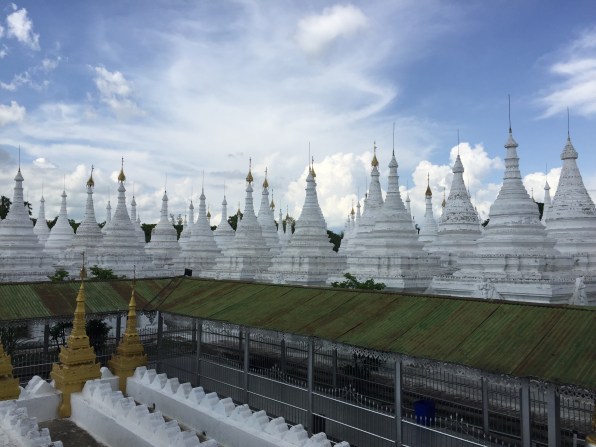
MYR 31

MYR 32

MYR 33

These four photos are some of our favorites that we took while in Myanmar.  They combine so much of what we loved about Myanmar.  The devotion to Buddhism.  The beautiful architecture and art.  The powerful sun, the deep blue sky and the omni-present puffy clouds in the background.

The following day, we took a day tour of the 3 ancient cities that neighbor Mandalay:  Amarapura, Sagaing and Inwa.  Each is a holy center and a former royal capital of (then) Burma.

U Bein Bridge – Longest Teak Bridge in the world at 0.75 miles long. We walked halfway across the bridge and back watching the fishing boats float through while trying to avoid falling off the railing-less bridge.
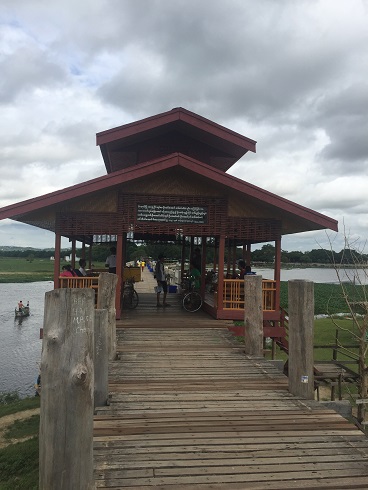
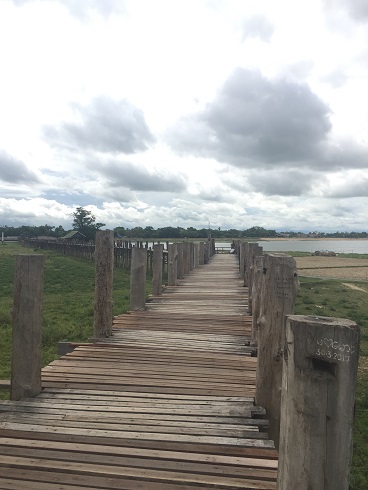
MYR 34

MYR 35

Myasetkyar Monastery – One of the largest schools for teaching children to become monks.  The school was started many years ago by a single donor and has now become a source of local pride which receives sizable donations from all over Myanmar.  Families donate to help build dormitories, provide meals for the prospective monks and bring gifts.  The gifts (often a substantial portion of family wealth) validate a well lived Buddhist life (charity and good works being necessary to achieve nirvana).

The novice monks ran in age from what appeared to be 5-6 years old all the way through adulthood.  We visited in the morning, so we got to witness the students lining up for their second and final meal of the day…at 11am in the morning.  Buddhist pilgrims (from all over the world) and well-wishers line up to watch the monks and to give them gifts of money, food and other useful items.
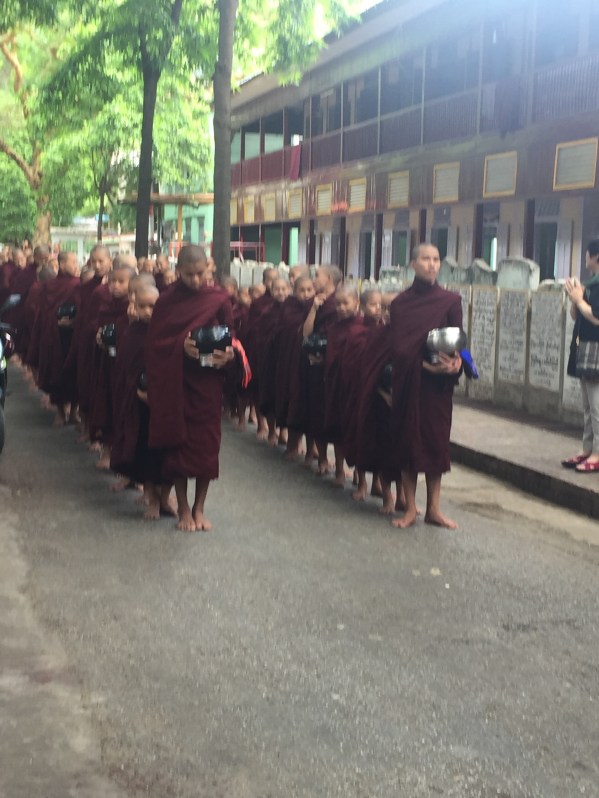
MYR 36

After leaving the monks in Amarapura, we headed to Sagaing Hills –

First we went to visit the U Min Thonze Pagoda.  Built into the hillside in the 1300’s, this is a whimsical pagoda full of Buddha statues with deep meaning.  There are 45 Buddha statues in total – one each for every year that the Buddha spent teaching his philosophy after achieving nirvana.

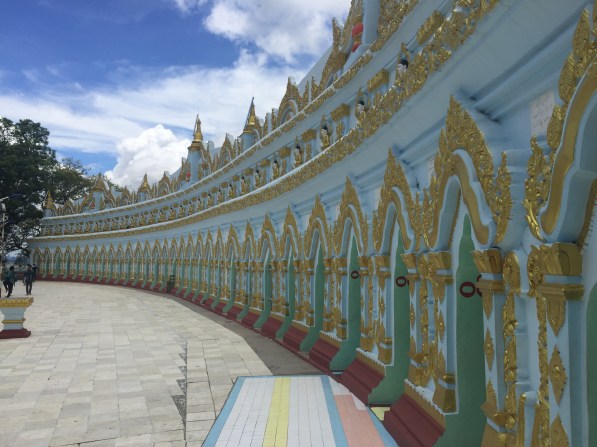
MYR 37

MYR 38

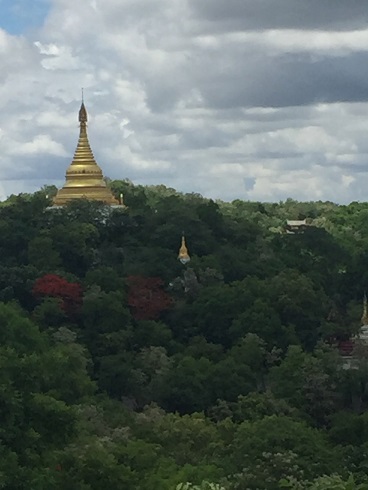
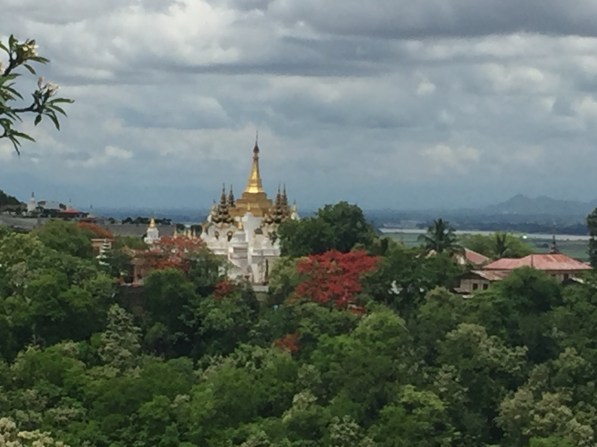
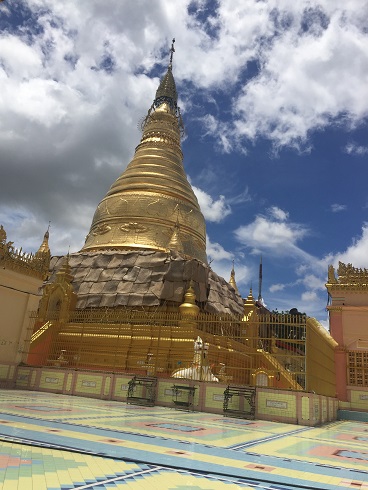
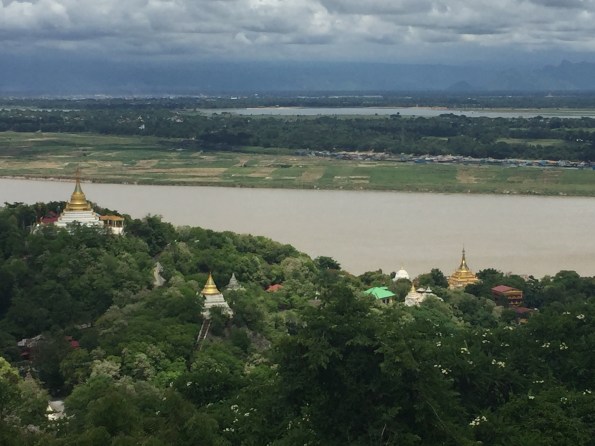
Next, we went to visit Soon U Ponya Shin Pagoda.  We’re up in the hills above Sagaing so the views are as spectacular as the Pagoda itself.  Please, again take note of the sun’s power, the blue sky and the gentle puffy clouds floating by.
MYR 39

MYR 40

MYR 41

MYR 42

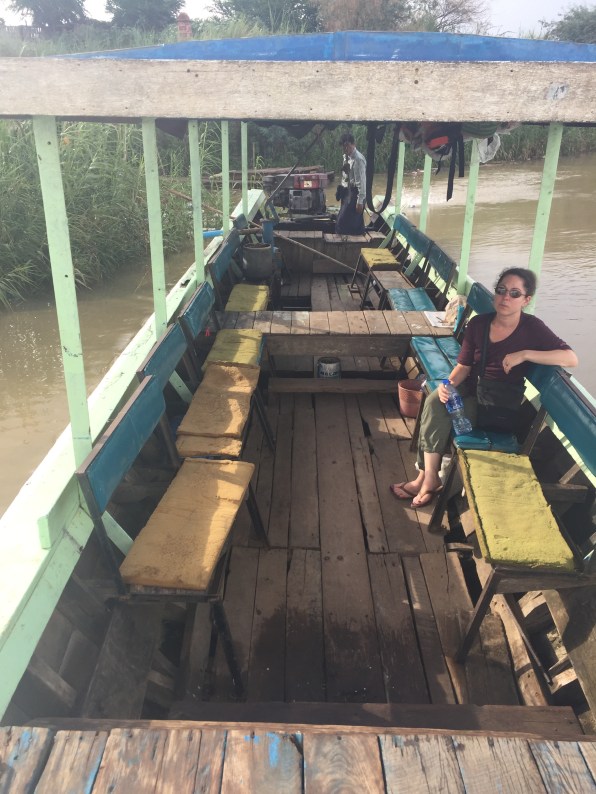
Inwa – The capital of Burma from the 14th-19th Centuries, Inwa was a well-protected capital city.  Located at the fork of two rivers, the rulers used natural barriers to provide protection.  Unfortunately, the capital cities aren’t well preserved as each successive ruler disassembled and moved the royal buildings or used their teak structures to make new temples, monasteries or palaces.  Part of the fun was the journey to and from the island.  First, we took a short ferry ride to cross the river and then a horse carriage around the island to see the sights.
MYR 43

MYR 44

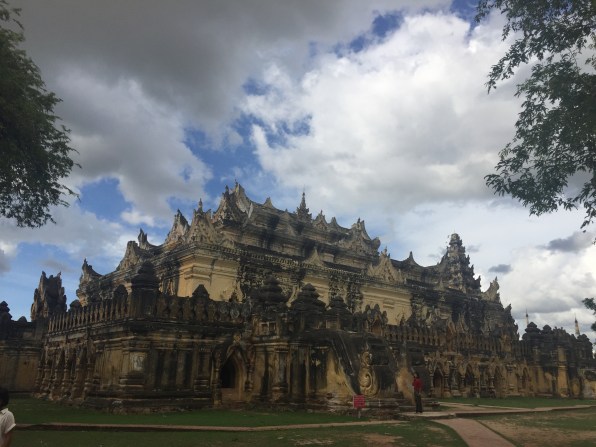
The main tourist attraction was a monastery built in the early 19th Century by the Chief Queen to the reigning King.  The Brick Monastery used more modern materials to replicate the teak monasteries that we’d seen previously.  Its absolutely massive and provided excellent coverage as a cloud burst let loose as we were inside the monastery.  Only 10-15 minutes in duration, the violence of the passing storm can’t be understated.
MYR 45

Inle Lake/Taunggyi

So now we’re in The Shan State.  If you’ve ever seen the Burma special that Top Gear of the BBC did, then you know what we’re talking about.  We’re starting to get out of the flood plains of southern Myanmar and starting to feel the impact of the eastern tail of the Himalayas.  That means mountains, glaciers and big lakes.  We didn’t go far north to see or feel the real mountainous peaks, but we did see the impact of the rivers and lakes.

We landed at the airport, rented a taxi for the day and went to Taunggyi.  The day turned out more spectacularly than our wildest dreams.  We stopped in Taunggyi to pick up a tourist pass for the region and a local guide from the Pao tribe.  This is important, and we’ll explain why in a second.

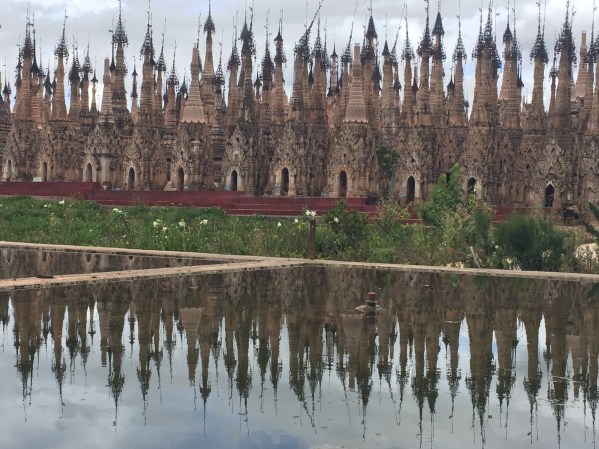
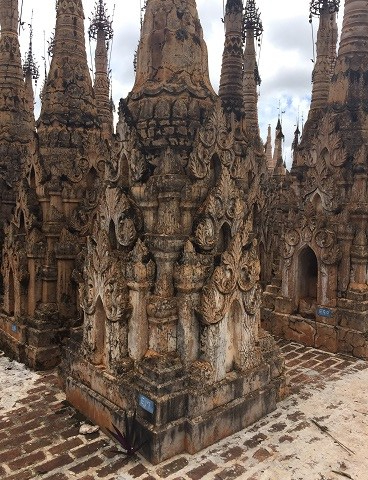
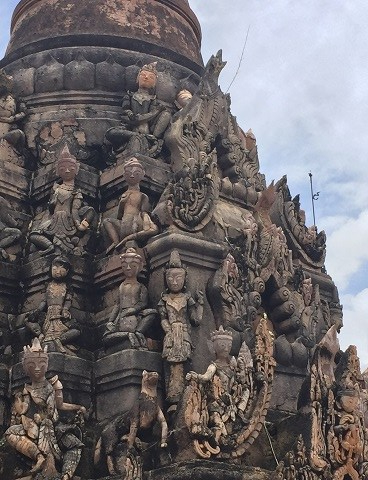
Our first stop was the Kakku Pagodas.  After driving for more than 2 hours, we arrived at a bit of a wonderous place.  The Kakku Pagodas were first started in the 3rd Century BC by King Asoka of India (there is some debate whether King Asoka himself came or just representatives from his court came to Myanmar).  The rest were completed over time and reached a peak of 7500 stupas.  Today only 2478 remain due to earthquakes and windstorms.

King Asoka was a Hindu King who converted to Buddhism and helped to spread the philosophy around South East Asia.  King Asoka is also famous for being the first opposition to Alexander the Great that repulsed the expansion of the Macedonian/Greek empire (in fact, Alexander died shortly after leaving India).  S has long been fascinated by Alexander the Great.  If you read our Bourdain piece, then you’ll understand when we say that Alexander has the second of the four seats at S’s dream table.  Both being great questioners and famous for their open minds, Alexander and Tony would be fast friends.

Oh yeah, the photos…MYR 46
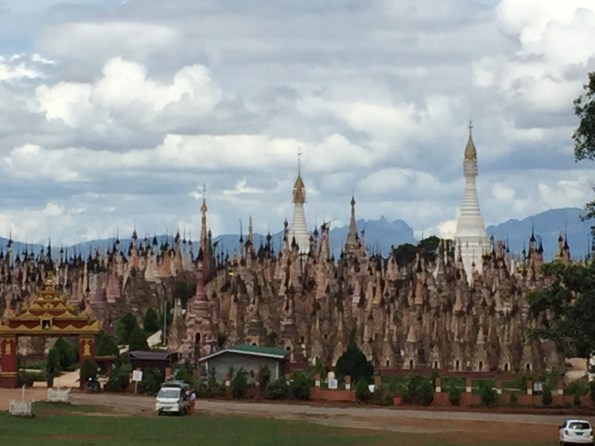
MYR 47

MYR 49

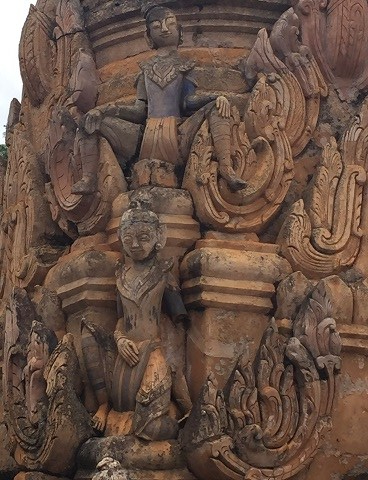
The decorations are on the stupas are fun and imaginative…

MYR 49

MYR 50

MYR 51

MYR 52

This is the original stupa built by King Asoka…
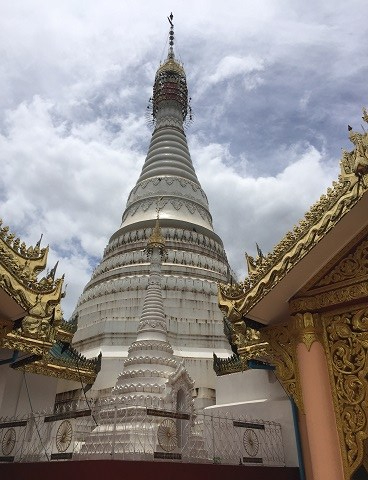
MYR 53

An adornment on a stupa…representing a Pao male in proper headdress and a Pao female with headdress (a dragon to represent that the Pao believe they descended from dragons).

MYR 54

After we left Kakku, we felt sated.  Like we’d lived what we were supposed to see that day.  However, in talking with our Pao guide, he mentioned this day was the last day of the rocket festival.  Say what?  In a hasty negotiation that involved us paying more to our driver, our guide took us to the ROCKET FESTIVAL.  The Pao people are farmers.  They need rain for a bountiful harvest.  In hopes of a good rainy season, they launch rockets into the sky as a tribute to the rain and sky gods.  Mostly it’s a party of food, beer and ROCKETS!

We were the only non-locals at the event.  That meant lots of pointing and staring, high fives and thumbs up.  People generously moved out of the way to give us a better view of the events

As we walked from the parking spot to the festival, we saw food stalls, clothing shops….Woosh!  What was that!  A rocket trail…
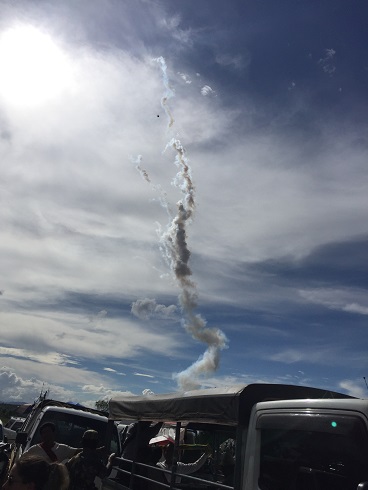
MYR 55

What else they do they sell here…oh I see…
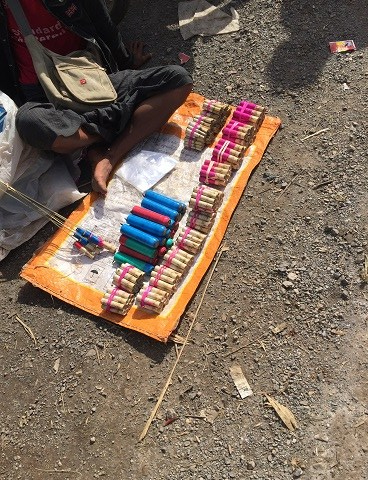
MYR 56

Is that what we’re here to see?…nope…this is…
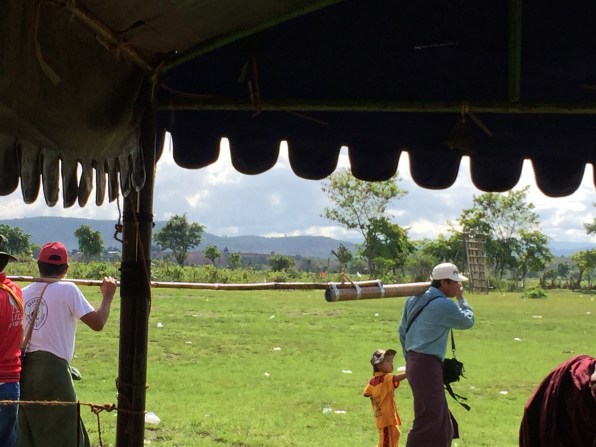
MYR 57

The picture doesn’t do it justice.  It’s a rocket strapped to a long piece of bamboo.  It takes 4 people to carry.  Holy snap!

OK, build up over.  This is what we came to see, and we caught it on video!!

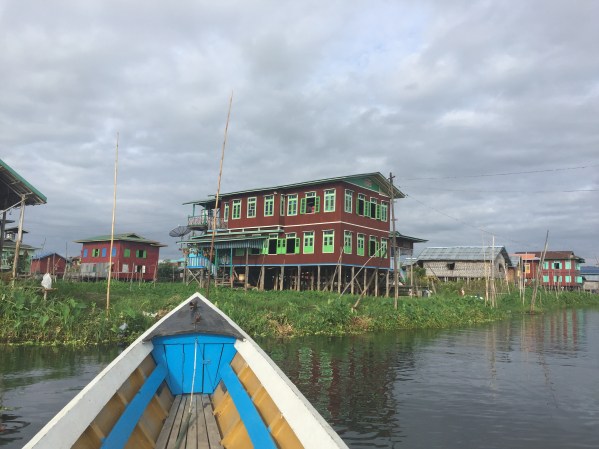
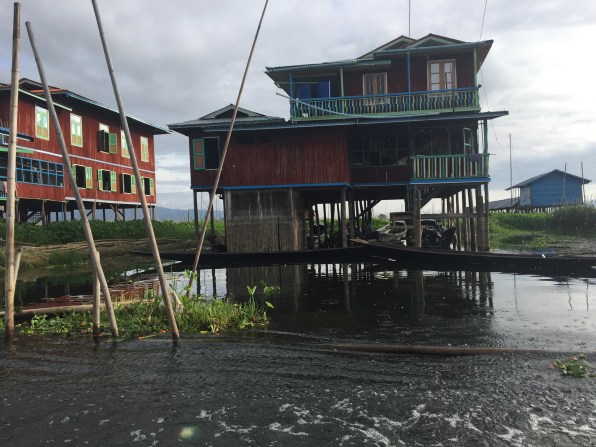
After a good night’s rest, we got up at 4am to meet our boat driver so we could walk to the jetty and get in our long boat.  We had to get an early start to watch sunrise as we (coincidentally) looked towards the backside of the hills on which Kakku was built.  The lake features many wonderful examples of pagodas, temples and monasteries.  But what makes the lake so special is how people have chosen to live on the lake.  They fish in the lake, but they grow crops on top of the lake.  They build houses on stilts in the lake, they take their kids to school on long boats and they visit floating markets for produce and other supplies.

The locals use weeds and plants that grow up from the lake bed on which to build seed beds and grow crops like tomatoes, squash and other vegetables for sale.
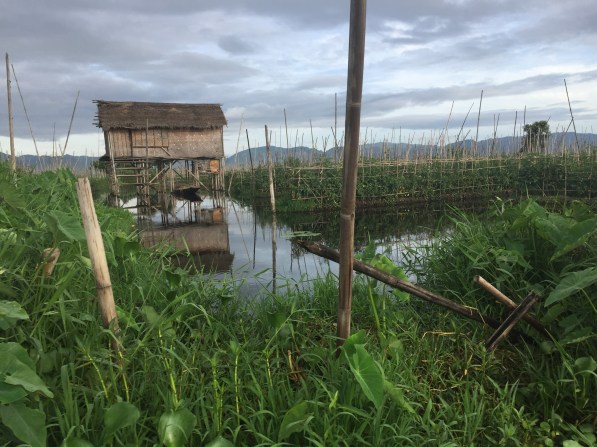
MYR 59

Homes built on stilts…

MYR 60

MYR 61

We don’t know what this building is but it’s too beautiful to leave out.
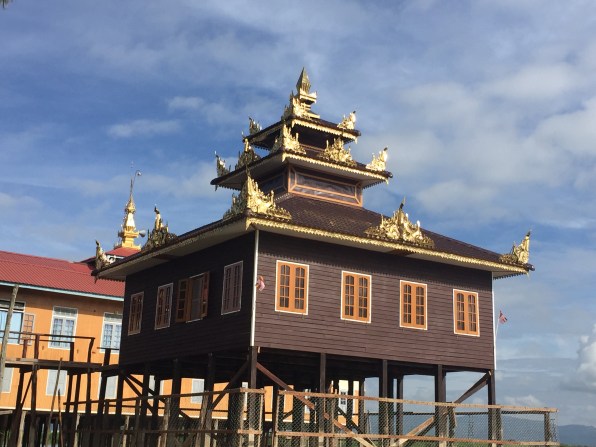
MYR 62

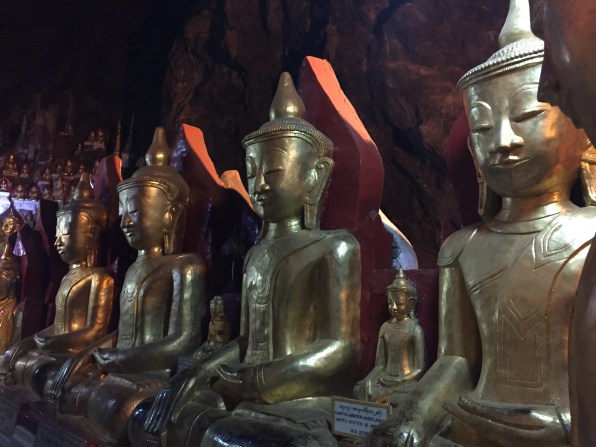
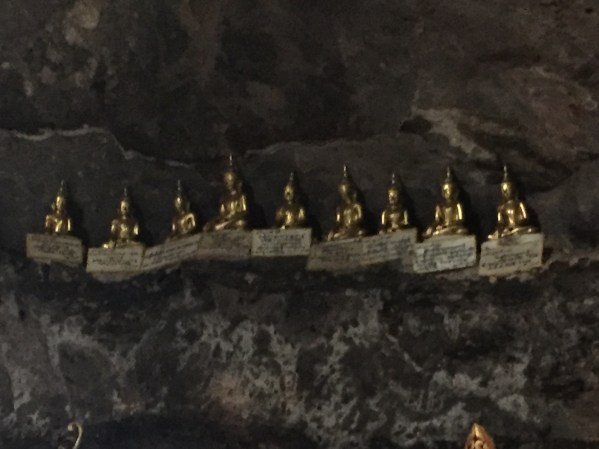
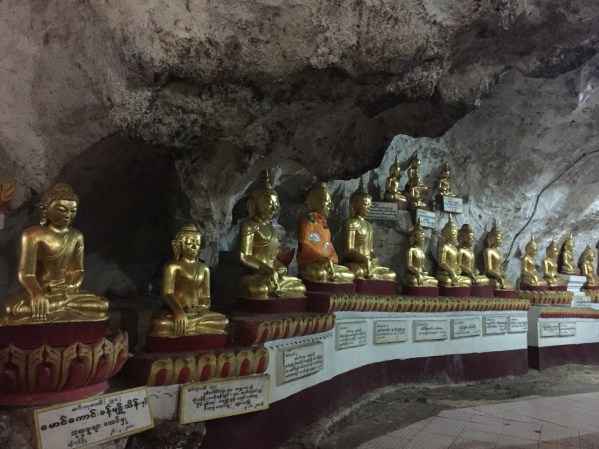
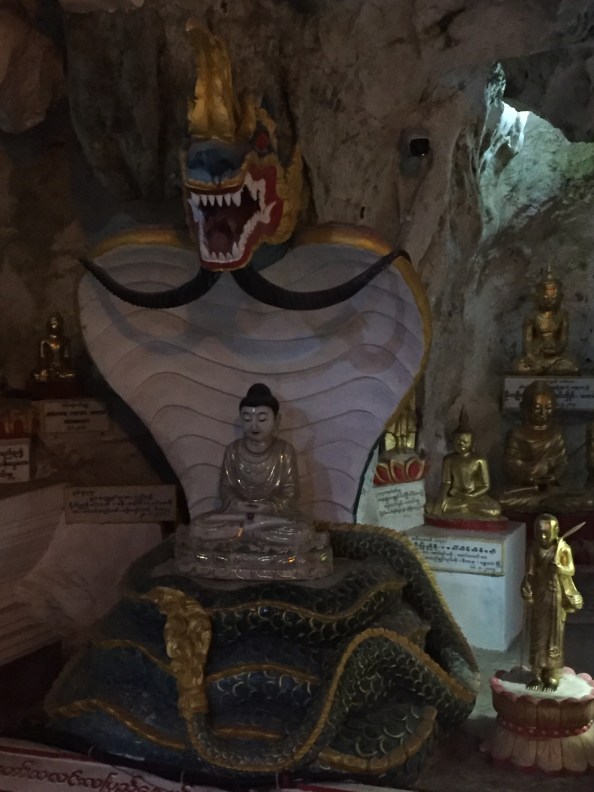
Before we headed to the airport the next day, we got an early start and headed to Pindaya Caves.  This was the last thing we did in Myanmar and we think it tied our whole experience together wonderfully.  Nobody is quite sure why, but people have been donating and sending Buddha statues for display in this cave for hundreds of years from all over the world.  It’s become a must visit pilgrimage site in Myanmar and makes for a pretty good tourist destination as well.  The statues are of all different sizes and literally wedged into every nook and cranny of the cave.
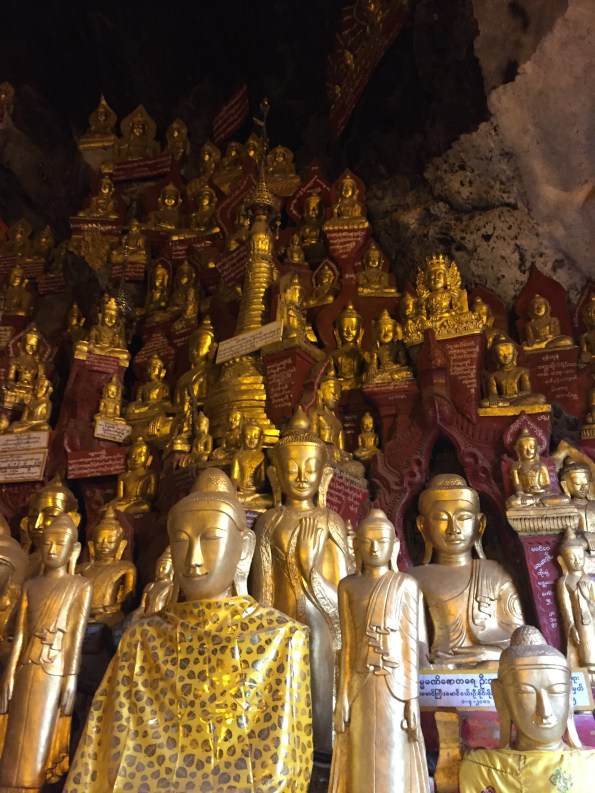
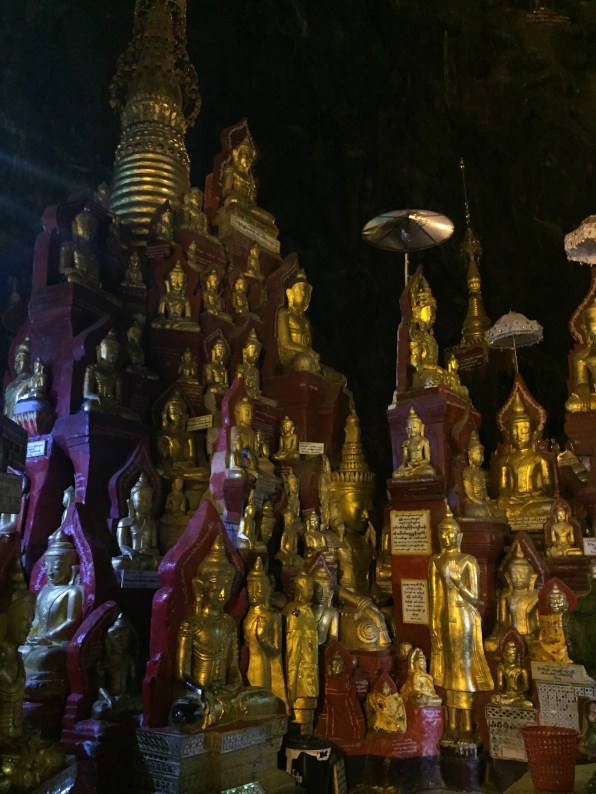
MYR 63

MYR 64

Some are little…

MYR 65

Some are big…

MYR 66

Some have water condense on them (known as perspiring Buddha)…
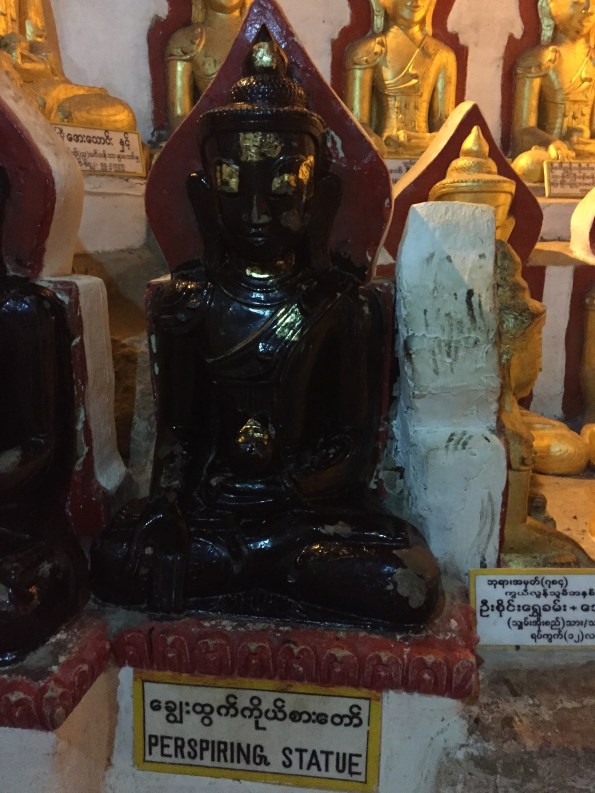
MYR 67

Some are high up…

MYR 68

Some are down low…

MYR 69

And some have unique pedestals…

MYR 70

So that’s it, a summary of our trip in 70 photos.  These photos and commentary will never fully paint the picture of how beautiful Myanmar is.  We hope that you enjoyed this post and that it inspires you to go to Myanmar.  It’s worth your time.  Believe us!

Myanmar Habitat Build: In Depth

When we come home from a Habitat for Humanity build, we get the same question, “how was it?”  It’s so hard to distill our experiences into words.  If you’re lucky, you get the short answer of “it was great, we can’t wait for the next one!”  If you’re unlucky, you get the slide show and the 30-minute answer.

Myanmar was our 4th build together, and we decided to take some time and go in depth to describe what a typical build and the daily routine entails.  In this post, we will give you a taste of the whole experience in Myanmar.  We will attempt to answer a lot of basic questions you may be curious about, but never asked.  Many of you have donated to one or all of our builds.  Hopefully this is a suitable reward.

Myanmar is one of the newer destinations for Habitat for Humanity.  We were one of the first builds with non-Habitat employee volunteers and a build not led by a Habitat employee.  Given that Myanmar still doesn’t have a country advisory board and minimal local staff, we had very low expectations for the ability of the local affiliate to organize and host a build.  We were told to be patient and flexible.  Boy were we wrong; the local affiliate had its act together and did a wonderful job.  It did require some patience and some carefully worded suggestions (which sometimes had to be re-worded the next day) but they delivered beautifully.

What kind of people give up a real vacation, go to a third world country to perform manual labor and either pay or fundraise for this?

Our team leaders, Bob and Leslie, have led over 50 Habitat for Humanity Global Village trips.  They have lived in Alaska for over 50 years and are retired teachers. They have given a lot of their free time to this cause, volunteering for Habitat for Humanity International for 2 ½ years and were assigned to the Asia/Pacific region and assisted 14 Asian countries get started in the Global Village Program.  They have also led many builds for Fuller Center (a Habitat like entity founded by the same individual who founded Habitat).  These are truly special people – the world needs more people like them.

Our group of 23 volunteers ranged in ages from 23 to their early 80’s.  We had a Pharmaceutical Engineer, IT Program Manager, a retired COO of the U.S. division of a major insurance company, retired school teachers, a retired counselor, a retired Architect, a Mechanical Engineer, a criminal justice policy analyst, a retired lawyer, a home maker, a public housing architect and a VP of Design for a major fashion company to name just a few.  There were more women than men and there were as many retired folks as those of us still working.

One female volunteer was from Singapore and everyone else was scattered throughout the United States.  California in the house!  We happened to have one volunteer from Sacramento, one from Santa Rosa, one from Oakland and one from Mill Valley – all in our backyard. Plus the two of us.

Some of our group had volunteered on more than 20 builds and we had two couples on the trip that met while participating on a build, one of which has been married now for 8 years.

Habitat for Humanity continues to draw in the best amongst us.  They are without question some of the best people we have met.  They are thoughtful, caring and above all else dedicated individuals.

NCDV5901

What was our daily routine?

We had our first “group dinner” on Saturday night at our hotel in Yangon.  Here we kept repeating each other’s names – trying to remember even a few of them.  The next morning, we drove two hours to Bago and checked into our guest house.  We had an orientation at 3:00pm with the local Affiliate staffers.  This was a very thorough, two-hour orientation that talked about Myanmar, the history of Habitat Myanmar, the families we would be assisting, safety on the job sites and a step by step power point presentation on how we would build two houses in just one week.

Monday through Friday were build days.  We had breakfast at 7:00am and then gathered for our “daily reflection” before being transported to our work site.  Although Habitat for Humanity is a Christian organization, our previous builds did not have any sort of “daily reflection.”  We were a little hesitant as we are more spiritual but don’t specifically subscribe to any particular religion.  We didn’t know what to expect.  However, this turned out to be a great part of our day.  Each morning, one person would volunteer and read a short motivational piece.  These generally lasted only a few minutes but were definitely thought provoking and stuck in the back of our minds all day.  Some have even stuck longer than that.  We were the first volunteers to lead a morning discussion.  We focused on the importance of service by weaving together a quote from the Buddha and the sage words of a fictional television President.

On our first day, as we arrived onsite, we had community members greet us with music and dance, a blessing (dripping water on our shoulders with a special tree branch) and giving us garlands.

Transportation – you may be wondering how long it took to get to our job site from our guesthouse.  We took a bus for about 30-minutes into a small township within Bago.  At this point, due to hideously bad road conditions, we hopped onto tuk tuks for the last 10 minutes.  On some days, the roads were super slick and muddy after torrential rain.  We would pile 6 to 8 of us onto each tuk tuk, and most times the tuk tuks didn’t have benches – so we huddled together on the floor.  On more than one occasion, the bumps would be violent enough that we’d fly across the tuk tuk and end up in each others’ laps.

tuk tuk

A typical build day started between 8:30am and 9:00am and ended at 4:00pm. Lunch was at noon; however, we always had a 15-minute break in the morning and afternoon.  They fed us plenty of snacks and cold drinks, and a full hot lunch.

Saturday, we took a break from work and ventured to The Golden Rock Pagoda.  This was one of the highlights of our trip and one of the greatest sites to see in Myanmar.

Golden Rock Pagoda

Sunday, we had a half day of work before the closing ceremony.  Each closing ceremony is unique to each culture but they’re always tearful and wonderful.  We dedicated both houses to the families – turning over ownership certificates with the volunteers making speeches to the village and the new homeowners.

Emily Team with Family 2

Emily Family Speech

It’s important to note that these are not just family events.  The entire village always turn out to celebrate the good fortune of their neighbors and the hard work of the volunteers.  The locals painted Thanaka on E’s face.  Thanaka is a sand colored paste made from ground tree bark, which helps keep one cool and provides sun protection.  it’s omnipresent.  If you’ve seen photos of Myanmarese women, then you’ve seen Thanaka on their cheeks and forehead.

Emily Dancing with Kids

During the ceremony, the same group of girls from the opening morning danced to loud music, then got most of us out on the dance floor.

That afternoon, we drove the two hours back to Yangon for one last night with the group.

Habitat takes good care of their volunteers.  They handle all health and insurance related issues during our visits, they pick modest but clean guest houses, they provide plenty of water and food and ensure you are having a great time building, in a safe manner.

How do you build a house in one week?  What was the process?

On the first morning, we were split into two groups and led to our job sites.  Before us stood cleared ground, with white chalk markings only. The first task was to start the foundation.  After digging several holes, we set bamboo posts into the holes and filled the newly dug holes with concrete.  Next, we moved the 4 pre-made frames into place and anchored them to the ground.  Then, we built short brick pillars around the bamboo posts, and filled the pillars in with concrete.  While some of team members worked with brick and cement others worked on splitting 15-20-foot bamboo logs into 2-inch-wide strips.  This involved using a machete to split a log into eight lengthwise pieces and then using a machete to strip out the inner chambers, so the bamboo can lay flat.  This was Day 1.

Start Day 1

Emily Driving Post

Salil Splitting Bamboo

PGFJ0458

End of Day 1

Day two, we began securing the framing with cross beams and continued to cut bamboo logs into strips to be used to secure the floors, walls and framing.  We had to use power drills to create holes for nuts and bolts to secure the horizontal beams and bamboo nails for the vertical beams.  Some also used machetes to turn 18-inch-long pieces of bamboo strips into bamboo nails.  This involved creating a sharp point at one end and turning the quarter inch square sides into a round or oval shape.  This was day 2.

End of Day 2

Day three we continued cutting two-inch wide strips of bamboo, stripped and cleaned them, then scored them with saws every 18 inches.  Then a battery-operated drill was used to create starter holes for metal nails when items needed to be fastened to the framing and cross beams.  The rest of the teams were securing bamboo logs to the floors with power drills and the bamboo nails to create a level floor.  In the afternoon, we added perpendicular logs to help support the flooring.  Before the day was over we also added roof struts to further tie the pre-made framing together.  These roof struts would also be used to the hold the roof in place.  We also started the stairs that led to the elevated floor of the home.  This was day 3.

End of Day 3

Day four we added floor boards and started to add precisely cut bamboo logs to create walls and door frames.  These logs also were held in place with the bamboo nails but often stayed in place without nails.  This was necessary to add to rigidity of the structure.  A corrugated metal roof was added.  We also added an elevated concrete and brick pad that held a giant plastic water jug that the families could use to store and capture water.  This was day 4.

End of Day 4

Day five we finished the stairs, added the pre-woven exterior bamboo walls and finished the interior walls.  We added an open hole that the family will later use to build an extension on the home (for a cooking area most likely) and a Buddha box (for their home temple).  We also began to prepare some steps for a New Zealand team that was arriving the day we left.  This was day 5.

Finsihed House

On our last day (Sunday – the half day), we treated the bamboo floors, beams and wall strips with vinegar and creosote for waterproofing, we hung a few doors and windows and completed a site cleanup.

salil house

What sort of tools do they provide onsite?

Usually, job sites don’t have enough tools to go around, so you must take turns with your team mates.  On this build, we had saws, DULL machetes and a battery powered drill (never seen any power tools on a build site except E’s first build in Romania).  S’s build site also had a battery powered drill, but we also had a gas-powered generator to drive a power drill.

You must be resourceful at times.  On E’s site, their only drill bit broke, so our fearless team leader Leslie made one out of a nail.  Talk about inventive – and it worked well considering.

They do however provide plenty of safety equipment including hardhats, extra gloves and eye protection for everyone.

So how does this build rank compared to our past experiences?

In many ways this was our most difficult build.  We thought that working with bamboo would be easy, but it required a lot of work to split, clean, score, saw, drill and nail.  We also thought a bamboo build would mean not having to mix mortar and concrete (easily the most physically demanding part of any build).  Wrong.  We had to almost continuously mix concrete and mortar several times a day, every day.  And lastly the heat was overwhelming – easily our hottest build.  The days would start hot and get hotter, but the humidity was a constant companion.  By the end of the first half hour, we were sweating completely through our clothes.  Adjusted for humidity, it was over 110 degrees and there’s very little shade on the job sites (until the roof went in).

E and S were nominated as water nags, so it was our job to make sure that our teammates were taking proper water breaks and taking timeout if they looked a little worse for the wear.  Thankfully, our teammates managed well and came out healthy.  There were a couple of nights that we stayed in and skipped dinner because we were so exhausted and worn out.

On the positive side, we successfully built two homes and met some incredible people.  From our group leaders to our teammates to the families to the local affiliate employees and our construction supervisors.  They are all wonderful people and better human beings.

Why do we build when we can’t possibly make anything but a small dent versus the larger need? 

We get this question from skeptics and even from the families themselves.

During one of our daily reflections, one gentleman told an important story that goes something like this: An old man is walking along the beach early one morning when he spots a young man throwing something into the ocean.  The old man approaches the young man and discovers that the young man is throwing starfish into the ocean.  The old man chastises the young man saying, “There’s hundreds of miles of ocean and tens of thousands of beached starfish.  You’ll never make difference.”  The young man shrugs and picks up a starfish and throws it into the ocean.  The young man then says, “I made a difference to that one.”

The teariest part of closing ceremonies is watching speechless families fully start to digest that they are homeowners now.  Maybe they get an inkling of how their lives might change, maybe they are struck by their good fortune or maybe they just don’t know how to comprehend that people they don’t know came to their small part of the world and did something nice.

What the families don’t always understand is that we get a lot out of these builds too.  All parents have dreams for their children.  Our parents had dreams for us.  But in Myanmar, for these two families, the gap between dreams and reality is just too darn wide.  The families don’t have the resources to close the gap.  But we know that kids with proper homes don’t get sick.  They can go to school and safely do their homework.  They can explore their curiosity.  They can leave the village and subsistence farming for a better life.

Selfie with Kids

Homes change lives.  They change the trajectory of what families can be.  These two homes will help in a big way.  Hopefully we made life a bit easier and their dreams slightly more accessible.  To say we helped two families and four children is an indescribable feeling.  One that will last longer than the homes we build.  Perhaps it’s the idealist in us but its helpful for everyone to know that we’re part of a larger global community and people you don’t know can and will do nice things for you.

Will we continue to work with Habitat? 

The building is hard work and the weather made it harder.  The tools are substandard.  Your clothes are always dirty.  Your hands are beaten up with cuts, bruises and blisters.  You sweat constantly and are never clean.  The beds are never great.  The hot water is never enough.  There are rats and snakes and ants and spiders and mosquitoes and all sorts of creepy crawlies everywhere.  The A/C and the power work intermittently.  The cold beer is never cold enough.  The food has too much meat or too much pork or not enough vegetables or too much tofu or too much fried food or too much rice.  But this a list of stuff you never remember when a build is done.  What you remember is the people that you helped and the people with whom you built.

A vacation on a beach somewhere might restore your mind and body, but what nurtures you soul?  What restores your faith in humanity?

So yes, we will build again and often.  It’s the most fulfilling thing we’ve ever done.  Until you participate in a build yourself, the full measure of our words and the total weight of our experiences can’t possibly make sense.  Just try it once.  You’ll be hooked.  They have a name for it; it’s called Habit-itis.

Not Another Anthony Bourdain Obituary!

This is not an obituary.  This is not an homage.  We’re not good enough writers to do either and frankly we don’t know Tony.  But this is our way of saying thank you.

We’ve all been asked or pondered who would be included in our dream dinner table.  Living or dead.  Pick four people from history with whom to have dinner.  For S, Bourdain has long been on his shortlist.

It’s taken us a few days to process our disbelief and mourn missing out on what stories will be left untold.  For that we’re all worse off.  So we apologize for this late addition to the celebration of his life.

There’s been a zeitgeist shift among millennials to pursue experiences over the acquisition of things.  We and millennials can quibble about a good many things but this is not one of them.  Since E and S met in December 2013, we’ve traveled to over 20 countries…mostly in the third world.  And not just the third world but literally to the poorest places in the poorest countries in the world.

Anthony Bourdain as much as anyone has made it cool to travel and to travel off the beaten path.  Don’t just go to big cities.  Go further.  Wander.  Ask questions.  Understand the locals point of view.  Eat what the locals eat.  Do what the locals do.  Drink what the locals drink.  Try to get a small taste of their experience (pun fully intended).  Just don’t be afraid.

Our global adventure was not empowered by Bourdain.  It wasn’t even inspired by Bourdain.  But to say he played no role would be disingenuous.  He gave us more confidence to visit places off the beaten path.  He gave us confidence to eat where and what we might not have.  He gave us confidence to drink where and what we might not have.  He gave us confidence to talk to people we would not ordinarily have.

Would we have gone to Zambia, Malawi, Laos and Myanmar without Bourdain’s television shows?  Probably but we might not have jumped in with both feet.  We might not have done so with full confidence.

One of our favorite Bourdain quotes goes something like this…Your body is not a temple.  It’s an amusement park.  Enjoy the ride.

We love this quote.  Love it even though we disagree with it.  It’s not worth discussing why.  We simply love the attitude.  The joy.  The purity.  Bourdain lived life his way.  Authentically.  Fully.  Unapologetically.  Insert your own adverb here.

Perhaps Bourdain the person and Bourdain the television persona couldn’t co-exist together any longer.  But we’re glad that he took us along for the ride for as long as he did.

So, thanks, Tony.  Kick back, grab a bowl of your beloved noodles, a cold beer and relax.  Undoubtedly nursing a hangover.  Now it’s our turn to bring you along for the ride.   To tell you a story.  There will always be a seat for you at our table.  We hope that we’re doing it right.

P.S.  Bourdain has said that if he could eat one meal for the rest of his life it would be at Swan Oyster Depot in San Francisco.  Just a few blocks from our home.  Really?  You may be gone but the long lines no doubt remain.  Damn you Tony!!!

Flavors of Vietnam

An important part of any travel for us involves exploring local foods and delicacies.  Our visit to Vietnam was no different.  Eating in Vietnam was going to be a highlight of our 3 months in Southeast Asia for sure.  And Vietnam did not disappoint.  We enjoyed eating our way through Vietnam and wanted to follow up to share some of our tasting experiences.

Vietnam is a big country made up of many different ethnic groups that only recently share a single government.  The country offers many different flavors and cuisines, with a saltier palette in the north and a sweeter palette in the south.  It’s also clear to us that the Vietnamese prefer less spicy food as the temperature rises.  Hence, more spicy food in the north and less so in the south – though overall – we didn’t find Vietnamese cuisine that spicy.  The trade and spice routes of Asia have also clearly factored into local cuisines with Thai, Indian, Chinese elements impossible to miss.  In sum, Vietnamese cuisine has an Asian base with an influence from the French and their cooking techniques.

We also dined in many different venues.  From proper sit-down restaurants, to bus rest stops, to food courts outside thrift markets, to cooking our own meal at a cooking class and to sampling street food curbside.  We even found restaurants that are seat yourself but be prepared to walk up a narrow winding staircase to the second floor (no vacancies), to the third floor (still no vacanacies) or to the fourth floor (finally a vacancy).  Slide uncomfortably between two narrow tables, sit down at a shared table and wait for the menus to arrive.

Our “go to” experience was street food or dining al fresco on the sidewalk at family owned establishments.  Sidewalk dining is technically illegal; however not policed often. That is why you will only find kid-sized plastic seats/stools and tables – so that when the police come, everyone can quickly move their food and furniture indoors.  Before the police are off the block, diners are back outside in the blink of an eye.

Street Dining in Hanoi

Yes, we love pho and ate it often; however, we also had the opportunity to try many other dishes.

  • Bún chả – By far our favorite dish – and the best soup dish in Vietnam. A sweet and tangy broth, accompanied by BBQ pork sliced thinly, sausage patties and rice noodles on the side (to add as you wish).  To finish off, you can customize the dish with lots of fresh herbs to adjust the flavor profile.

Bun Cha

  • Bánh cuốn – Thin rice crepe filled with ground chicken and mushrooms (typically consumed for breakfast).  The rice crepe itself is made from a thin rice flour batter that is ladled onto a silk screen over a pot of boiling water.  Cover the batter and in just a few seconds one has a perfect crepe.  The accompaniment is a dipping sauce that the diner customizes.  Start with water and sugar.  Add lime or kumquat for acid.  Add fish sauce for tang and saltiness.  Finish with salt, pepper, garlic and chilies for spicy heat.  Mash together and enjoy.

Banh Cuon

  • Nem cua bể – Deep fried shrimp and pork spring rolls.  These are standard on every menu.  Each family and restaurant have a unique recipe but they’re always delicious.

Nem Cua Be

  • Bánh mì – Delicious sandwich with fresh French bread, with meat, salad and spices.  A good one costs about $1.25 in Hanoi!!  The French may have left Vietnam but thankfully they left their bread making prowess behind.

Banh My

  • Nộm bò khô – Dried beef salad with papaya, and beef jerky.  Everything is pickled perfectly and finished with herbs and roasted peanuts.  The dressing is a fairly standard mix of vinegar, soy sauce, sugar, fish sauce, chili sauce and other herbs.  The salad is sublime, but the aroma is the star.  Stunning!

Nom Bo Kho - Thai Beef Salad

  • Che – Dessert soup – with coconut cream, young green sticky rice, jelly and fruit.  The Vietnamese don’t do dessert the way we are used to but what they have is quite good.  The texture takes some getting used to but the flavors and freshness work.  And it has coconut milk, so we’re good.

Che - Viet Dessert


  • Bánh rán ngọt – Deep fried sesame seed rice dough ball filled with mung bean paste.  We’ve all seen versions of this dish in dim sum restaurants, but this is the Vietnamese version.

Banh Ran Ngot

  • Ca Phe Trung – This was an interesting one – an egg coffee (see photo below).  That’s right, coffee with a thick egg cream instead of milk.  Back in the day when milk was expensive/hard to obtain, someone decided to substitute it with egg yolk.  You beat egg yolks with sugar and a little rum until it’s extremely thick and then pour that into your coffee.  This was a little too sweet for our taste.  We preferred and consumed MANY Ca Phe Sua Da – iced coffee with condensed milk.  On the very hot and humid days in Hanoi or Ho Chi Minh City, a ca phe sua da hits the spot.  As the ice melts the coffee becomes less sludgy and dilutes the condensed milk.  It’s perfect in every way.

Ca Phe Trung

  • Hot Pot – Sit at a mini table in the middle of the Street.  Order chicken, beef, pork, fish and vegetables.  They light a Sterno-type candle and put it in the center of a potholder.  Soon out comes a big pot of soup.  Shortly thereafter comes the food order accompanies by cabbage, carrots, onions and other vegetables with noodles.  Cook the food at your leisure and keep ordering cold beer.  A perfect meal with plenty of people watching for entertainment.  Oh and it’s not more than $5 per person.

Our cooking class was very enjoyable.  We had the opportunity to make Bun Cha (our favorite soup), Chicken Lettuce Cups, Nem Cua Be (fried spring rolls), Fusion Salad (tropical fruits with a sweet tangy dressing) and Banana Fritters for dessert (see photos below).  We also learned to make tomato roses and carrot accents, so our dishes looked pretty.

Cooking Class

Banana fritter

We have all the recipes from our class and if you are lucky – we will try them out when we are back home after our big adventure.

So yes, come to Vietnam for the natural beauty.  Come see Ha Long Bay in all its glory.  Visit the Mekong Delta and their unique culture.  Visit the cities – big and small.  Walk the rice paddies and the broad avenues.  Learn to cross the street without getting hit by motor scooters, cars and buses.  Shop in fancy malls or local thrift markets.  But don’t miss the food.  Pull up a mini chair, order a beer and get ready to dig in!


Habitat for Humanity Build – Who Are We Helping In Myanmar?

We have a few hours to spare as we lounge in the Singapore Airport before our flight to Yangon, Myanmar and thought we would take the time to talk about the two families we will be helping in Myanmar.

Family One –

U Kyaw Min Oo is 32 years old and his wife is four years older than him.  They have no house in their village, so they are staying in the small house where the wife’s mother used to live (we have included a picture of their current house below). They have inherited a piece of land right in front of the current house they are staying in.  They have two sons; tragically, one of them has a heart condition.  He needs daily medication to survive. Family 1 Portrait

Family 1 Home

Both U Kyaw Min Oo and his wife do not have stable jobs.  They just take whatever jobs are available for them in the village. U Kyaw Min Oo works as a farmer and fisherman during the rainy season and can earn up to 3,000 Myanmar Kyat ($2.28 USD) per day.  His wife can earn 1,500 Myanmar Kyat ($1.14 USD) a day from rolling cigarettes.  They sometimes don’t have jobs for days and weeks at a time.

All their hard-earned money goes to their daily needs such as food, clothing and medicine for their son.  It is not possible to save enough money so that they can build their own home.  They are very grateful to our team for helping them and will be able to focus their energy on the health and education of their children.

Family Two-

Daw Win Than is 48 years old and her husband is 50 years old (he is not in the family picture, as he was working the day it was taken).  They have 4 children, of which only one has been married.  They all live together in their current house. The younger son and daughter are still attending school.

Family 2 Portrait with home

Family 2 Home

U Kyaw Soe is a farmer and a fisherman in rainy season and earns 4,000 Myanmar Kyat ($3.50 USD) per day.  When rainy season is over, it’s much harder to get a job.  When he isn’t working, they don’t have any income, so they have to spend the little money they can spare earned during the rainy season for food and clothing.

Daw Win Than and her daughter roll tobacco cigarettes just to cover their daily meals. They can make up to 3,000 Myanmar Kyat ($2.28 USD) per day rolling cigarettes.

How are the Families Chosen?  While we don’t have exact details for families in Myanmar, we can rely on our experiences from prior builds.  The families are generally chosen by community religious leaders that have deemed the families as having both a need and sufficient social capital to have earned a new home.  The families also need to own the land and must participate in the building of their home.

Why are Homes Important?  Because children can’t go to school when they’re sick and homes with leaky walls and roofs facilitate illness.  New homes rectify these situations and hopefully contribute to the families being able to break the cycle of subsistence farming and underemployment.  All of the parents and grandparents that we’ve met hope that their children can be properly educated, get superior paying jobs outside the village and pursue options that the families haven’t historically had.  In short, they change the life trajectories of these families. There is more need than resources but that’s not a good reason to avoid participating or to avoid donating.

We feel honored to take part in such a worthwhile cause – the aid of families with children.  These are the poorest of the poor in the poorest parts of the world.  But they’re virtuous people that share the exact same hopes and dreams that we all have.  They want better lives for their children and families than they themselves had.  But sadly, they don’t have the tools or education or the local institutions to make those goals achievable.

We don’t get anything directly from these builds except a little satisfaction and lots of good memories (which hopefully last as long as the homes do!!).  Many of you know this is Emily’s 5th build and Salil’s 4th build (our build leaders have participated in 40+ builds – hooray).  While we have already surpassed our fundraising goal for this build, we are currently fundraising for our next one; which we hope to sign up for later this year, or the first quarter of 2019.  Please consider making a small donation by clicking on the link below and please share this link with your friends and family.

https://share.habitat.org/globalvillage-mehtaforgv

Thank you for your continued support and love!

Random Thoughts and Things We Learned During Our First Month of Travel in Southeast Asia

As hard as it is to believe, we’re a few days past the One Month Anniversary of our trip.  So far, we’ve been through Tokyo’s Narita Airport (the Star Alliance Lounge has a killer, serve yourself sake bar!!), Thailand, Laos and now we’re nearing the end of our journey in Vietnam.  In a few days we leave for 2 days in Singapore and some true R&R.  This is notable because we will soon be in Myanmar and our Habitat for Humanity build in Bago.

So far, we’ve taken 4 flights and 3 overnight trains (one in Thailand and two in Vietnam).  We’ve spent 1 overnight stay on a Junk boat (Ha Long Bay, Vietnam) and 3 overnight stays in rural villages (one in Laos and two in Vietnam).  We’ve checked in and out of 15 hotels, traveled many hundreds of kilometers on buses, experienced the kindness of many strangers, journeyed with 3 group tour leaders (who were all fantastic), drank lots of beer (and more than a little local moonshine whisky) and tasted great Street Food.

Our favorite places you ask?  Well that’s two places.  One was Vang Vieng in Laos.  A wonderful town of natural beauty.  We unfortunately had to keep moving but a few extra days would have been lovely.  Two was Hoi An in Vietnam.  A UNESCO World Heritage city on the banks of the Thu Bon River.  Loads of beautiful bridges, a perfect beach and a picturesque old town full of colorful lanterns and narrow pedestrian only streets.  We also met a cute older couple while on a bike tour of Hoi An.  Their visages are featured on every marketing brochure for Hoi An.  They’ve been married for 75 years and are adorable together.  They generously shared their time with us and showed their still vibrant feelings for each other.

Hoi An E&S

Hoi An River Scene

Hoi An Couple

Our favorite meal?  We’re preparing a longer post on Street Food in Hanoi, but Bun Cha was our favorite meal so far.  If you know Pho, then you only know the second-best soup in Vietnam.  By the way, if you pronounce Pho as Fo (or like the long “O” sound), you’re close but not quite right.  If you’re confident that Pho is correctly pronounced so that it rhymes with Duh, you’re also wrong – you’re asking for Street.  As best as we can explain in a blog post, it’s properly pronounced as Fuuuuhhhhh (with a subtle higher pitch at the end as if you’re asking a question).  All those accents in Vietnamese words are important pronunciation clues as similar looking words can have as many as 6 different meanings based on those tricky accents.  Tragically the difference between Shut up and Thank you are very subtle.

Here are some random thoughts and things we learned in our first month –

  • The White Temple in Chiang Rai. On the way from Chiang Mai to the Laos border, we passed through the town of Chiang Rai – a small town with one of the more beautiful temples we’ve ever seen.  Sure, it’s modern kitsch with some anti-consumerist homages but it’s stunningly beautiful.  The temple is a replacement for an older decrepit temple but it’s being re-cast by a local artist who has spent almost US$1.5 million of his own money to buy the land, build the new temple and the associated complex.  The vision won’t be complete until 2070 but it’s hard to not be awed by the man’s devotion to art and Buddhism.

IMG_0730

  • No alcohol can be purchased in Thailand between 2pm and 5pm – everyday. And that includes hotels, bars, grocery stores and mini-markets.  The rule aims to prevent high school aged kids from buying and consuming alcohol on their way home from school.  There are some obvious flaws or loop-holes with this rule, but the rule seems to have stuck regardless.  We’re also told that you can’t buy alcohol during the 5 national Buddhist holidays nor during elections.  I’ve heard of drinking after elections but during voting?  Yeah, good point.
  • Hey! Wait a second!  Weren’t they?    The cars in Thailand are right hand drive.  That means the cars drive on the left side of the road or does it?  For most of Chiang Mai that appears true.  However, inside the walls of the old city, where we were staying, cars drive on the right side of the road.  We don’t quite get it, but it causes double takes and confirming glances before crossing busy streets.
  • No Ladies Allowed. Some temples in Southeast Asia are men only or have specific sections that are forbidden for women to enter.  Some temples exclude women during menstruation but in some cases the rule seems to have been expanded to exclude women for impurity reasons.  Alrighty then.
  • What gives Mr. Bezos? Amazon Prime Music works fine in Southeast Asia, but Amazon Prime Video does not work at all.  What the heck?
  • How we plan to stay fit during our travels. We’ve fallen in love with a workout app called Aaptiv.  It costs $50 per year but it’s brought new inspiration and routines to our gym workouts both at home and on the road.  The concept is that the app features instructor lead workout regimens.  They have many different categories including treadmill, outdoor running, yoga, meditation and strength training to name a few.  All of them include instruction/motivation and energetic music.  Critical for us, Aaptiv also has indoor, full body strength training workouts that run from 15-60 minutes.  These don’t require any special equipment except for a bit of floor space.  So far, it’s worked well in our hotel rooms and left us a bit sore the next few days.
  • If you grab for a green bag of Lays potato chips, what flavor do you expect? Sour cream and onion, right? In Southeast Asia, you get seaweed or Nori flavor. If you grab a turquoise bag of Lays one expects to get vinegar and salt. Instead one gets sour cream and onion. Orange gets one BBQ flavor, right? Ok so that’s still true.  Gotta read the labels. Yep, we got burned by the old seaweed switcheroo.

Nori Flavored Chips

  • 7-11 sandos. We were on a backpackers’ tour in Thailand and Laos. Fellow travelers were kids (ages 17-24) from all over the world, including England, Ireland, Denmark, Singapore, Brazil and The Netherlands.  The kids are living on toasted sandwiches from 7-11 (the stores are everywhere in Thailand). Standard ham and cheese toasted on white bread. Not sure what they cost but it’s required for their travel budgets. For us, food is an important part of the journey but for them socializing with global citizens is more important. That means skimping on food to max out the beer budget. Two of the younger travelers were from England.  They’d just finished high school and deferred college for a year to travel.  They had spent significant time in New Zealand and Australia before arriving in Southeast Asia.  We’ve heard that kids outside the US grow up faster and mature earlier than American kids.  If these two are any indication, that’s certainly true.  There’s no way we were ready at similar ages to travel the world unaccompanied by adults.  These two were mature, fun, smart and street wise.  We parted with them in Vientiane (the capital city of Laos) and wish them well.
  • S ate a salad in Thailand and lived (so far). Despite the warnings to the contrary, we’re told that municipal water in Thailand and Laos is purified and all ice is provided by regulated sources.  It’s still a risk to drink the tap water or eat uncooked veggies but we’ve been safe so far.  How do you know your ice is safe? It will be a cylindrical shape with a hole in the middle.
  • Napkins are scarce but WIFI is plentiful. Like much of the world, the Internet has become an absolute necessity.  Restaurants, hotels and even roadside rest stops have free WIFI with passwords posted in menus and on street signs.  But don’t expect a napkin if you order a meal.  You must specially request them and even then, you get a thin piece of paper no bigger than your hand. Sometimes one gets a roll of toilet paper.
  • Bangkok is a big city. World class. Chiang Mai reminds us of Siem Reap, Cambodia (which we visited on a previous trip). A medium sized city. Full of beautiful temples without big buildings. Lots of cheap guest houses and restaurants. Bangkok is premium priced, Chiang Mai is moderate to cheap. For example (shout out to our friend GH in Arlington), a generic lager beer in Bangkok is US$2-3.  In Chiang Mai, you can get 3 of the very same beers for US$3.  Again, for GH, order one at a time because at 95 degrees with humidity, the beers get warm fast…about 5 minutes.  At which point, GH would only be one-third done with the first beer.  Inside joke but trust us, it’s funny.
  • The Best Super Mullet Ever!! Dayyum!

IMG_0746 (002)

  • Many hotels are obviously non-smoking, thank goodness. In addition, they are also “non durian” – durian is a fruit about the size of a small watermelon with a thick skin that looks like a hedgehog rolled up into a defensive posture. While it’s regarded as the “King of Fruit” here in Southeast Asia durian smells so bad that hotels do not allow them to be opened and consumed in enclosed spaces.  For those of you who don’t know what durian is and/or are up for a challenge – it has an unpleasant aroma (some describe it as smelling like sewage, turpentine or rotten onions) but has a custard like texture with the flavor of almonds.  However, don’t confuse a durian for a jackfruit – which is very similar in appearance; the outer shell of the jackfruit has a more-subtle rounded point texture as opposed to the sharp points of the durian fruit.

No Durian

  • The public bathroom experience in Southeast Asia will be different than what you are used to at home. They will not be very clean, will almost never have toilet paper and in most cases will be a simple squat style (hole in the ground).  If this doesn’t already sound very appealing – you also get the privilege of paying for this experience.  Usually, it isn’t much more than the equivalent of $0.25 USD.  Make sure you have exact change though – otherwise they will take your money and smile and shake their head and gesture that they don’t have change (even if they do).  Some advice – always have toilet paper with you and embrace the bum gun (we will let you look this up on your own).
  • In Asian culture, the lighter your skin is – the better. This is a bigger concern for women than men.  Yes, you will see a lot of Asian women walking around with umbrellas to shield their skin from sunlight.  You will also see most female motor bike drivers wearing face masks not just for the air pollution, but to block the sun.  You will also find it difficult to buy any moisturizer that doesn’t have “whitening cream” in it.  And we mean whitening cream (think Michael Jackson) and not anti-tanning sunblock.
  • We’ve mastered a new sport – crossing the street in Vietnam.  Cars stop at red lights, but motor bikes don’t.  Seriously, motor bike drivers NEVER stop for you.  They simply move around you like a flock of birds avoiding an obstacle.  As a pedestrian, the general rule of thumb is you stop for cars/buses/trucks and continue walking into traffic when it’s only motor bikes.  They come from all directions and you are not even protected on a sidewalk.  To the motor bike drivers, a sidewalk is a shortcut!  Even when walking on the street parallel to traffic, one walks in the street.  Between street vendors, motor bikes parked on the sidewalk and motor bikes driving on the sidewalk, the street is the relative pedestrian safe zone.  As we write this, with two days left in Vietnam, we are proud to say we have not yet been hit (as our friend did twice during his stay in Ho Chi Minh City).  The key is to pick a tempo and direction and stick to it.  Hesitate and you confuse the driver.  Confuse the driver and the chances of being hit go up.
  • You can visit the market and come out feeling like a winner. We went to Ben Thanh Market to purchase a few articles of clothing.  Incidentally, Ben Thanh market was built in the mid 19th Century by French colonialists and quickly became the center of commerce (of then Saigon and now Ho Chi Minh City).  E wanted to get a few knockoff Nike and Under Armor water wicking shirts (by the way, you cannot tell the difference between an authentic shirt or these).  S wanted to grab some pants for our build next week.  There are no marked prices on any items throughout, and you are encouraged to bargain.  E settled on three shirts with a starting suggested price of 880,000 Vietnamese Dong and managed to purchase them at a final offer of 370,000 Vietnamese Dong (just over US$15 for all three).  S found two pairs of Columbia pants with a starting price of 900,000 Vietnamese Dong and managed to purchase them at a final offer of 250,000 Vietnamese Dong (about US$11).  This was quite a successful shopping experience.  Lesson learned – you can bargain the price down even lower than the 50% off that is suggested by most travelers.  We started at less than half of the suggested price and never budged.  We even walked away several times until we got the price we wanted.  Unfortunately, we will never know if we could have negotiated an even lower price but the deals we struck seemed fair to both sides.

We know this post is a lengthy one.  It was difficult to summarize what we have shared together over the past month into one blog post.  We hope to post smaller, more digestible pieces in the future now that our group tours are over and we will be spending more time travelling on our own.

We hope you have enjoyed reading about our adventures so far.

A Glorious Week in Laos

Sabaidi!  [Hello in Laos]

In continuation of our adventurous border crossing post, we spent an amazing week in Northern Laos.  The night we arrived, we stayed in Hoay Xai – a quaint little town just across the border.  We had a nice dinner, experienced one heckuva thunderstorm and went to bed rather early, anticipating our next two days on a slow boat.

The slow boat fit close to 100 passengers (it’s about 140 feet long and not more than 12 feet wide); however, we were lucky to have it as a private trip for our group of about 15 people.  A family owns and operates it – a husband/wife and their three young kids (plus a bun in the oven).  This was a relaxing couple of days – slowly drifting down the Mekong River towards Luang Prabang.  We had no Internet (oh, the humanity of it all!!) so were able to catch up on reading, converse with our fellow travelers, play cards, drink local whiskey and just kick back and relax.

Salil slowboatGroup slowboat

We stopped for a night in a local, secluded village.  The village is about 300 years old and has roughly 280 members.  The villagers are mostly subsistence farmers but some have found outside employment.  What they lack in resources, our new friends more than make up in generosity, humility (before Buddha) and enthusiasm.  Despite the poverty of Laos, the villagers all have proper homes with brick walls and running water.  We even spotted a few satellite dishes.

Upon our arrival, we gathered in what appeared to be their town hall.  The village elders welcomed us with a Baci (welcoming ceremony) where each of them tied MANY cotton bracelets on us and blessed us to ensure a safe and successful journey.  We also consumed MANY shots of local Laos Whiskey (made from sticky rice) – at least four in total, one for each arm and leg.  The villagers sang us traditional songs and then it was our turn to reciprocate.  Our original thought was Bohemian Rhapsody but too many of our group didn’t know the words.  E then had a brain storm and we quickly settled on Twinkle Twinkle Little Star – including the hand movements.  Sidebar – Everybody knows Twinkle Twinkle, right?  Apparently, the non-native English speakers had never heard the song so we had to quickly teach them the lyrics.  The villagers couldn’t sing but they had fun with the hand movements.

Baci Ceremony

Cotton Bracelets Laos

Although we couldn’t communicate with the locals – we joined in some traditional Laotian dances to their traditional music.  After a bit, our tour leader ran up to S and said that the villagers wanted to hear our music.  After a little bit of panic (given that S’s phone has lots of …rock and heavy metal), he finally settled on shuffling the Black Eyed Peas.  While our tour group danced the night away, the villagers eyed us like crazy people.  After lots of begging we got some of the older women and teenage girls to join us…though they did so with giggles and reluctantly.

When it came time for “lights out,” we were separated into groups of 3 and escorted into individual villager’s homes for the night.  They were excellent hosts.  In the middle of the night, some strong thunderstorms blew through the village.  The roofs of the huts are formed with corrugated metal – just imagine the sound and volume as the rain came down in sheets.  Although this made sleep impossible – we loved every minute of it.

After returning to our slow boat, we continued our drift down the Mekong River to Luang Prabang.  The quintessential no stop light town is a haven for backpackers and travelers.  Over the next two days, we went swimming in a beautiful series of waterfalls and had the opportunity to be rice farmers for half a day – where we learned and actively participated in all 14 steps of producing sticky rice (including walking barefoot in the 1 ½ foot thick mud and guiding an ox in tilling the mud patty).

Laos Waterfall

Emily rice paddy

From Luang Prabang, we hopped on a bus and drove to Vang Vieng.  The natural beauty of Laos generally and Vang Vieng specifically can’t be understated.  The town features a backdrop of tall pointy mountains, a slow-moving river and a lush green landscape.  We LOVED it here and wish we could have hopped off the bus for a few more days.  The first afternoon, we went swimming in a blue lagoon.

The highlight of Vang Vieng was the river tubing trip the next day.  Think barhopping and tubing all in one.  It takes about three hours if you don’t stop along the way; however, the bar owners along the river bank make it all too easy to stop.  They toss weighted water bottles attached to ropes to you – and pull you into the bank.  The bars were a blast – full of loud music, cheap drinks and warm food.  Each bar has a slightly different vibe – one had a field in which we played frisbee and soccer, one had a platform that allowed us to dive into a deep spot in the river, one had an elevated platform where we played flip cup and beer pong with the locals.  Note that the locals played beer pong with Lao whiskey while the visitors played with lemon drop shots.  Then you go back into the river, float until you see the next bar – and this repeats a few times.  The slate walls and mountains make for a beautiful landscape and reward a slow float down the river…until sunset anyways when one needs to quickly exit the water and the quickly chilling night air.

tubing out of the water

Salemily tubing selfie

Group tubing shot

Beer pong

Nitrous Balloon

We were surprised to see how “open” Vang Vieng was.  Although Laos is a communist country, you could buy nitrous oxide (think laughing gas) balloons from bars, magic mushroom shakes on the street, venture into a “space bar” and order all sorts of drugs openly off a menu for public consumption.  Sorry to disappoint you, but we stuck to beer and the local rice whiskey.

Bars in Laos seem to welcome bar hoppers.  Many bars regularly feature free drinks for an hour – say from 8-9pm or 9-10pm.  We noticed this promotion in more than one town in Laos.  We don’t fully understand it, but it seems to work for the local bars.

We were sad to leave this town; the vibe of the town and the natural beauty are mesmerizing.  Many from our backpacking tour stayed behind to climb the mountains for the epic views of the valleys below.  Given our flights to Vietnam, we had to continue our journey to Vientiane, the capital city and our final stop in Loas.  Vientiane feels like a big city complete with tourist attractions, the Presidential Palace and other government buildings.  We visited the COPE center, a non-profit organization that educates visitors and raises awareness for victims of UXO (unexploded ordinance) and the secret war.  For those of you who are not aware, more 200 tons of munitions were dropped on Laos by The United States (to disrupt the Ho Chi Minh trail which veered from Vietnam into Laos).  Much of which remain tragically undetonated.  Laotian villagers are routinely maimed and killed by the bombs (which are being harvested as scrap metal for much needed income) when they detonate half a century later.

To end on a more positive note, we want to stress how much we enjoyed Laos, and ask that you please put this gem on your list of places to visit in Southeast Asia.  Most people have been to Thailand and Vietnam, but Laos is the friendly, less developed version of both.  It remains undisturbed by consumerism and friendlier for tourists wanting the local experience (THERE ARE NO CHAIN STORES IN LAOS – THANK HEAVENS).  Beer and food are more expensive than Thailand but everything else is cheaper.  The natural beauty is stunning, and the humility of the people is inviting.

The danger of planning a trip like ours is that we get the time allocations wrong.  We would heartily steal time from other places and reallocate it to Laos.

Khobchailailai [Thank you very much in Laos]

Our First Land Border Crossing (Thailand into Laos)

Trivia question.  Everybody knows that the Thai currency is the Baht.  Who knows what the Laotian currency is called?  See the answer below.

Most fellow travelers arrive in a new country via flight; sometimes you cross a border into a new country by car.  Usually it is a very straightforward process.  You hand over your passport and get a stamp – and then you welcome yourself into that country.

Crossing the border from Thailand into Laos had a lengthier process and provided some good entertainment.

Step 1 – We first arrived at the Thai border patrol.  We had to hand over our passports and departure card (make sure you hang onto this from when you first arrived Thailand or it could be a hefty fine).  The Thai border patrol will check to be sure you didn’t overstay your 30-day tourist visa (if you do you have to pay a small fine) and will stamp you out of their country.

Step 2 – Once we “left Thailand”, you are in a waiting area that is considered “No Man’s Land”.  There you wait for a bus to shuttle passengers and their luggage to the border crossing into Laos.  We don’t believe that you can walk from the Thailand exit area to the Laos arrival area.  Despite friendly relations between Laos and Thailand, this “No Man’s Land” is heavily fenced with razor wire.  This ¼ mile or so piece of land is neither in Thailand nor Laos.  Had we arrived an hour later, we would have had to spend the night in this area until the border reopened into Lao the next morning.

Step 3 – Pay 20 Thai Baht (about $0.64 USD) and board a smelly bus with your luggage.  The bus ride is only about 1-2 minutes, and you arrive at the Laos border crossing.

Step 4 – Hand over your passport, along with a passport photo and US$35.00 for the visa processing fee.  Since we arrived late in the day, the Laos government tacked on an “overtime fee” of 10,000 Kip ($1.21 USD).  This fee must be paid if you arrive between 4:00pm and 7:00pm daily.

Step 5 – Wait around for 10-20 minutes until your name is called and your passport is returned to you with a full page, very intricate visa – which is good for one single entry only, up to 30 days.

Laos Visa Pic

Step 6 – Walk through the last barrier, with nothing to declare – and we were greeted with a “Welcome to Laos” sign; like the famous Hollywood” sign – however much, much smaller.

Welcome to Laos Sign

This marks the 2nd country in our Southeast Asia adventure and look forward to exploring Laos for the next 10 days.

P.S.  For you world travelers.  One important item we’ve noted in Asia is that when you make a payment to a government or to a restaurant or even to a street vendor, the bills must be in excellent shape.  It doesn’t matter if one is talking about local currency or US Dollars.  The bills must be crisp with no dog ears and tears or they will not be accepted.  This is not reciprocal however as change is often returned in “weathered” bills.

P.P.S.  A second lesson is that even if one pays in US Dollars, the change is always returned in tattered bills local currency.

Songkran and the Thai Water Festival

super soaker pic

Songkran is the Thai New Year’s Festival that begins every April 13.  Songkran comes from the Sanskrit word meaning astrological passage.  To you and us, it means change or transformation.  While the holiday occurs close to the beginning of Spring, the New Year begins with the ascension of Aries on the astrological chart.  For simplicity purposes, the Thais celebrate it every April 13 for tradition’s sake even if the celestially important date is different.

One of the Songkran traditions is for individuals and monks to pour water over Buddha statues as a sign of reverence.  The symbolism is meant to indicate the cleansing of one’s soul and washing away sins at the start of the New Year.  But Thais and tourists have taken this to a whole new level.  Thus, enter the Water Festival.

In Chiang Mai, Songkran also means that the whole city shuts down for an enormous water fight.  Everyone (all ages from toddlers to the most senior) participates and everyone is vulnerable to getting hosed (literally).  People buy super soaker style water guns (see our photo above) and buckets.  Restaurants and street vendors put out big oil drums and continuously fill them with water to ‘arm’ the celebrants.  From about 9am to 7pm (when the oil drums are wheeled away), the city is one giant (and we mean giant) water fight.  The only safe space is in a restaurant or bar.  Sit outside at a restaurant and you will be destroyed with water.

All strategies are fair game apparently.  From singling out an individual for a group attack to a full on cross-street battle with passersby…and everything in between.  The big winner are the people flinging ice chilled water.  Get hit by a bucket of ice cold water or even a stream from a gun and it freezes you for a moment (pun intended).   For example, see the videos below to get a small taste of the Water Festival.  The first video is from a scene we witnessed after we crossed the street to avoid the buckets of water being hurled on the 12th.  The second, from the 13th gives a fuller picture of the chaos and fun.  The second video was shot from inside an open air restaurant of the street scene outside the restaurant.

Our favorite strategy is using the slowdown in traffic to drench people in songthaews, bikes, motorbikes, mopeds and cars. A songthaew is a cheap and popular form of transport in Chiang Mai.  It’s a minibus that holds up to 10 passengers, but its really a pickup truck with two benches running along the bed of the truck and a shell covering the passengers.  There are windows that run the broad side of the shell promoting air flow and an open doorway in the back though which passengers enter and exit the vehicle.

When a songthaew stops or slows down, one can walk up to the window and slide it open exposing the unsuspecting passengers to a good rinsing.  Or one can walk up to the back door and unload your water inventory onto the passengers.  Buckets are an especially good choice for songthaews and its passengers.

The one part of the game we haven’t figured out yet is how to deal with pickup trucks.  There are generally 4-6 passengers riding in the back of the truck with a huge drum of ice cold water.  We have super soakers full of ambient temperature water and they have buckets full of ice cold water.  It’s a no contest.  We lose, they win.

All in all, it was a great way to celebrate the Thai New Year and an auspicious way to start our global adventure.

So a couple of tips if one plans on attending Songkran –

One, everything one carries has to be in a waterproof holder or leave it at the hotel.  Every inch of you will be drenched by the end of the day and it will be a continuous cycle of wet then dry then wet then dry.  Hotels and travel agents hand out special, waterproof holders for phones and money.  They only cost about 10-20 Thai Baht on the street (33-67 cents USD) and they are a lifesaver.

Two, embrace it.  You’re going to get soaked so just have fun with it.  The only bummer is people use river (very dirty and smelly) water and some people insist on shooting you in the face.  The latter is a no-no because the water can be unsafe in Thailand.  That means wearing sunglasses and keeping your mouth closed during skirmishes.  But again, one must grin and bear it.

Three, technically the Water Festival and the water fights begin on April 13.  We took a songthaew from the train station to our hotel and we quickly learned that the fights start on the 12th.  We met a friend in Chiang Mai and he noted that water guns were being sold at least a week before the water festival officially began, so people were prepared early. Traditionally, the Water Festival runs 3 days through the 15th.  As we post this on the 16th, we are drying clothes that got drenched from the constant barrage during our 2-hour ride back from an elephant park because participants seemingly needed just one more day of fun.  As for tomorrow, stay tuned.

Four, we enjoyed both the water fights but also visiting the temples and seeing the more formal ceremonies marking the beginning of the Thai New Year.  We started the 13th early with the official kick off ceremony to festivities and the small parade that featured prominently in the ceremony.  The Mayor of Chiang Mai and the regional Governor were in attendance.  Notably, Miss Universe Thailand (she finished in the Top 5) was in attendance as well.  See the following two photos from the kick off ceremony.  Note that the ceremony is ostensibly Buddhist but has strong Hindu influence.

parade photo 2

parade photo 1

Five, while the Water Festival officially runs for 3 days, we assure you that one day of participation is sufficient.  Especially when we started fighting at about 9:30am (we were the victims of a random attack while eating breakfast) and went until about 7pm.  It was an exhilarating and epic day filled with laughs and good times.  It didn’t matter if you were fighting Thais, Chinese, Europeans or fellow Americans, a good time was paramount.  That said, one day of being soaked through and through was enough.

Six, we picked a hotel in the center of the action near the East Gate (Tha Phae) of old Chiang Mai.  That’s the good news and the bad news.  There was no escaping the water fights or the mass chaos.  We would very likely choose the same hotel again but this time with open eyes.

Final Thought:  This kind of festival works beautifully in Thailand because the locals are kind-hearted and happy people.  There is nothing malicious in their Water Festival.  It’s pure expressions of joy in celebrating the New Year.  Any thoughts as to how this might work in your local community?  Let us know what you think in the comment section below.

And We Are Off!

Although we are writing this from our hotel room on the fourth day of our adventure (Chiang Mai, Thailand), its not too late to write a kick off the trip post, right?.  In reality, the dimensions of this trip – the full duration and the distance we will travel – hasn’t hit us yet.  It still feels like one of our typical vacation trips.  We’re still in the honeymoon phase of our trip, so….Yep, a kick off post still feels appropriate.

For the Southeast Asia portion of our journey, a few numbers that might help dimension our travels the next few months…7 countries, 15 flights, 3 overnight trains, 27 different hotels, 1 overnight junk boat and 3 villages for overnight stays.  Not to mention a couple of long train rides and many, many long bus rides.

We are especially excited for the handful of prop plane rides intra-Myanmar.  Yay!

We hope that you’ll follow us periodically on our journey and we hope to post more frequently with fun stories, our adventures and some miscellaneous thoughts.

To receive email updates when we add a new post, please click on the button that appears in the bottom right of your screen.  It’ll look like a “+ Follow …”.  Click on the “+ Follow portion” of the bug, not the 3 dots. Submit your email address and you’ll receive a confirmation email from WordPress.  Click on the link in the email and you’ll be a confirmed subscriber!  When we post a new memory from our adventure, you’ll receive an email.