Day 0 – Some Road Trip Details

After 18 months of sabbatical and 15 months of Covid lockdown, we have decided to embark on a 47-day driving trip around the US.  Generically, we’re going to hit some states that we haven’t been to before and make some adjustments to the usual Route 66 itinerary from Chicago to Santa Monica.  For the exact itinerary, you’ll have to follow along to this blog.  Please subscribe by hitting the Follow button in the bottom corner of your screen…enter your email address and you will receive a notification with all our new posts.

Different than what we’ve done in the past, this will be a photo heavy series of blog postings.  Easier to peruse for you and easier to post for us.

Please allow us to introduce you to the newest member our family.  She’s Swedish and blonde.  Of course, I’m talking about our new Volvo.  We’ve named her Sigrid, which means victory, beautiful, wisdom.  We agree…she’s all three!

Yep, blinded by the sun. But focus on Sigrid.

Odomoter reading before we began was 647 miles.

Taking Flamenco Guitar Classes in Sevilla

E and I visited Madrid over Thanksgiving 2016 and we went to see a very touristy Flamenco Tablao.  The dancers and their footwork, the singers and their emotion, the clapping and THE GUITARS!  Despite not understanding the tradition, the interplay, the music structure or the history, I was hooked.  I needed to learn more about this art form.

Some of you may know that I picked up the guitar while in college.  I took lessons in college and then continued them after graduation.  During my 7 year detour to New York and subsequent return to San Francisco, I continued my guitar journey but mostly as a self-taught noodler.  I learned technique mostly by playing songs in which I had interest but this fostered some bad habits, as I’ll discuss below.

When E and I chose Sevilla as our first choice to live in Spain, flamenco was an important reason.  While there is no formal capital of flamenco, Sevilla and Granada are two important centers of flamenco in Spain.  There are at least 17 styles of flamenco.  Sevilla being home to just one style.  Flamenco is a fusion of traditions – some Arabic, some Indian, some Andalusian, some Romani and some North African.  No different than southern Spain itself!

After arriving in Sevilla, I began to look for studios and teachers from whom to learn flamenco guitar.  I quickly ruled out group classes.  I didn’t want to get stuck between people that didn’t know the difference between an F chord and a capo.  I also didn’t want to be constantly chasing players far superior than I.  But that meant having to find a private lesson.

After emailing a few teachers, I settled on a female teacher, who happened to be from Virginia but had been studying and living in Sevilla for quite a few years.  Mi nueva professora de guitarra solved a couple of problems.  Primero, mi espanol es muy malo.  My teacher had to be proficient in English.  Check.  And secondly, I didn’t want to traipse all over the city with my guitar during rainy season.  She lives a quick 5 minute walk from the apartment (barring I didn’t get lost every fricking time).

A quick digression.  Sevilla is an old town and wasn’t made for navigating with GPS.  There is an intersection that I need to navigate which has 8 streets that meet at one intersection.  8!  Choose the wrong one and there is no way to recover except for returning to this confusing intersection.  Luckily I’ve never gotten lost twice on the same trip, but in the rain it can be quite frustrating.  Some of my lessons have also been before sunset and some after sunset, so the intersection and buildings never look quite the same.  And it’s the craziest thing…I only get lost on the way to her place but never coming home.  It’s very strange.

I opted for lessons twice a week.  Monday and Thursday evenings.

During my first lesson, I used my teacher’s stage guitar.  It’s beautiful with a wonderful tone.  It’s worth noting at this point that a flamenco guitar is different from an acoustic guitar or a Spanish classical guitar.  A traditional acoustic guitar is mostly likely to have all 6 strings made from the same material (all nylon or all metal).  A flamenco guitar has 3 strings of steel and 3 of nylon – as does a Spanish classical guitar.  An acoustic guitar might also have a cutaway that allows the player to access the higher frets.  A Spanish classical guitar and a flamenco guitar only leave 12 frets accessible to the player.  A flamenco guitar is generally thinner (front to back) than a Spanish classical guitar and has less internal bracing.

When it came time to buy my own guitar, my teacher sent me to a nearby guitar store.  I of course opted for a Spanish classical guitar and not a flamenco guitar.  Why?  It was much cheaper and more durable for travel.  I also got a guitar tuner, a capo and a hardcase.  As I progress and the difference becomes important, I can always upgrade to a true flamenco guitar.

During my first lesson, my teacher covered some basic vocabulary of flamenco guitar and emphasized that the best way to learn flamenco was to watch as much live flamenco guitar as possible (even if on youtube).  Sevilla is full of places at which to watch flamenco.  Touristy bars, formal tablaos and informal open mic nights.  Very near our place is a bar at which amateur musicians meet.  There are often several guitar players, singers and sometimes even a dancer or two.  Grab a beer, sit nearby and soak it all in.

Back to the first lesson….and then we got started making music.  In the first lesson, we were going to learn technique by exploring the palo, Solea. Palo means more than song.  Each palo has implications for chord structure, song structure, rhythm and region of origin.  The rhythm cycle needs to be mastered.  It’s this deeper meaning of song that holds flamenco together and allows singers, dancers and guitar players to perform together even if they’ve never met.

Solea is based on a fairly simple 12 beat cycle and is based on the Phrygian scale (if you know your classical modes).  We would break down the song into various pieces – the main compas (strumming or rhythm portion) and the various falsetas (the guitar solo – so far I’ve learned 3 variations).  Plus numerous fills and alternatives to the paseos and falsetas.

No two guitar players will play Solea or any palo exactly the same.  The guitar player has options so long as the themes of the palo are respected.  Other than that, the goal is to begin each part of the song slowly and slowly build in intensity and for the entire composition to begin slowly and finish at the peak of intensity.  The only other question to be answered is whether the guitar leads the dancer or the dancer leads the singer.  Lastly, the singer and the dancer will never perform at the same time but the guitar player can accompany both or remain silent.

The first set of techniques to master is the Rosgueo – the ubiquitous finger strumming technique of which there are many.  One rosgueo I’ve learned involves sweeping the strings in quick succession with the ring, middle and index finger.  There are some variations which are important, but the technique is simple enough.  Coordination on the other hand is more difficult especially when moving strings to account for different chords.  Other techniques involve using mainly the thumb to sweep strings both up and down.  Simple enough, but there are variations that add to the texture of the song and some variety for the ear.  Another technique involves strumming three string with the thumb, picking the fourth string with the index finger and then hitting the first string only with the thumb.  When played quickly, this is very beautiful.

The second set of techniques to master are for falsetas – the guitar solos.  Luckily in Solea each falseta I’ve learned follows a similar basic pattern.  Except they don’t.  They rhyme but are just different enough to tell them apart.  Anyway, I’ve learned three falsetas, but again the guitar player has choices and is allowed to improvise.  I can play the first two pretty cleanly and at good tempos.  The third one is a monster of complexity and freely switches techniques back and forth.  I’m still fumbling at low speeds with this last one.

There are three techniques central to playing the falsetas that I’ve learned.  If it’s a simple three string arpeggio played on consecutive strings (generally the three bottom strings), the thumb plays the top two strings and the index finger plays the bottom string.  If it’s a slightly more complicated multi string arpeggio with string skipping, then the thumb plays all of the strings except for the bottom string which is again played by the pointer finger.  And for the most complicated arpeggios (with both multiple strings and multiple notes played on the same string), then the notes are played a bit more like a rock and roll finger style (the thumb plays the top two strings and the other strings each have a finger dedicated to it).  While for the strings with multiple notes on it, the pointer finger and middle finger work to pick the string with alternating upstrokes (like a bass guitar). This requires the right hand to change position depending on what’s required.

An important challenge is to learn to relax my right hand.  Let it drape naturally over the strings vs leaving tension in the hand.  This allows for more variety of movement (needed for switching between techniques) but also for speed.

The first two falsetas I mentioned above use the first technique described above.  The break between the paseos and the falsetas use the middle technique.  The third and most complex falseta uses the third technique.

So what immediately became clear to me is that flamenco guitar is totally different from the rock or blues guitar that I had been learning.  First and foremost, flamenco is all about the right hand.  Most of the guitar I had been learning was mostly about the left hand.  Leaving aside matters of coordination, where the heck do I look?  I can play my electric guitar without ever looking at my right hand.  Now I needed two sets of eyes to properly catalog my mistakes and I now had two sets of mistakes to catalog – left hand and right hand.  Second, playing with a pick is much easier than playing flamenco finger style.  Third, to the extent that I knew how to play finger style (say for Babe I’m Gonna Leave You or Stairway to Heaven by Led Zeppelin) – the flamenco finger style can be totally different.

What’s also become clear to me is that I have two bad habits or lazy habits that are being exposed in flamenco.  Nobody has ever corrected these errors, and at the speeds needed in flamenco, these habits will be speed inhibitors.  The first is that my left thumb likes to creep over the neck especially when playing the higher octave G-B-E strings.  I’ve got to work on arching my fingers a bit more and keep my thumb firmly planted at the center of the neck.  The second is that I’ve learned to use my right pinkie as an anchor or fulcrum point when playing with a pick.  The right hand needs to be more relaxed to properly play the flourishes and arpeggios that an anchored right hand won’t allow.  An anchored pinkie also helps me “feel“ where my hand was relative to the strings, so I never needed to look at my right hand.  Learning to gently rest my fingers on the bottom string or to play with a floating right hand will prove to be a challenge until it becomes my new normal.

Each of my lessons is comprised of three parts.  During the first part, we review the prior lessons and play the entire palo…compas and falsetas.  The second part is to build on what we’ve learned and add new portions of the palo.  Lastly, we work on technique exercises that mimic the palo but focus on technique.  Flamenco is traditionally taught only by oral tradition (nothing is ever written down) but we document our lessons with video that I can review for details or to practice along with.

As our time in Sevilla grew to a close and the flamenco guitar lessons with them, we’ve finished the main elements of Solea and have built a large library of techniques for me to practice during our time away from Sevilla.  I hope to find an instructor in Santiago, Chile but there is plenty for me to work on in case we don’t find one.  My instructor has emphasized that flamenco involves learning from multiple sources so nothing in my education will be impaired by finding a different instructor with different viewpoints.  In fact, it might even be desirable.

Flamenco guitar when played properly is mesmerizing.  Unfortunately, very little in my nearly 30 years of playing guitar has prepared me for the flamenco guitar.  As a matter of fact, I have to unlearn as much as I’m learning.  The good news is that my teacher is very patient and happy to work on building a good foundation.  We’re solidifying a plan that I can follow without her dutiful eye next year until we return to Sevilla next June.


In the meantime, you should feel bad for E because my practice sessions are chock full of repetitious errors followed by a partially successful run.  The good news is that I’m seeing progress.  I just wouldn’t hold out hope for seeing me perform in a show anytime soon.

Co-working in Sevilla

During the first 5 months of our travel, it’s been almost impossible to build a work day routine.  Between the various time zones, hotels and forms of transportation, I’ve had to sneak in reading time whenever we’ve had access to internet or time to sit and reflect.

In my world, knowledge is geometric.  It builds on itself, so lost time is almost a permanent loss.  I’m thankful that E has always given me time to work and attempt some sort of daily routine.

Getting to Sevilla would be the first time since April in which each of us would have a daily routine.  E at school and me at a proper office.  E picked her school well in advance of our arrival in Spain because she needed to reserve a space.  Picking office space for me was much harder because visiting the space was critical.  I have worked in co-working space with open floor plans before and found it a very comfortable environment.  E helped find several good options and in our first few days in Sevilla we planned to visit them.  I say them, but our decision was made when we visited the first location.  Arcadia Co-Working was going to be my home for 3 months.

When we first walked into Arcadia, Victor (one of the two proprietors) met us and was very generous with his time.  He explained contract terms, helped Emily and I select desks (Emily worked at Arcadia for a week before her school term began) and even took time to show us some fun nightlife spots on a tourist map he had.  We weren’t going to meet a cooler guy than this, so we signed the deal right then and there.  We didn’t need to visit any other spaces.

We didn’t meet Victor’s business partner, Sergio, til later, but he’s equally as wonderful a guy.  If everyone in the world were as caring and pleasant as these two gentlemen, the world would be a far better place.  These guys are Arcadia and if you don’t like them, then Arcadia isn’t for you.  Plus there’s likely something wrong with you.  Get them started on movies, comic books or Star Wars and you’ll need to pull up a chair.

Sevilla is a conservative place culturally.  Yes, Sevillanos are progressive minded but they respect traditions.  In this case, tradition means working in a corporate office.  Co-working space is viewed skeptically or as a bit weird.  The proprietors of Arcadia, Sergio and Victor, are on a mission to bring a more flexible work environment to Sevilla.  Around the world, temporary workers, contract workers and vendors are becoming a larger and larger part of the economy.  Leaving aside the complex employment rules in Spain, telecommuting and contract work allows global reach for knowledge workers (aka digital nomads).  And in Spain, there is a talented work force that can be tapped by global employers.

So where do these modern-day digital nomads work?  Working from home is a bit too informal and lacks proper structure.  Securing proper office space is expensive and clunky given strict lease terms.  The latter doesn’t work for irregular contract lengths and flexible projects.  Hence the global rise of the co-working model.  Sign a contract for as long as you like for as many employees as you like.  Want a flexible desk, pay less.  Want same desk daily, pay more.  Everything else is on an a la carte basis – pay as you go for conference space or for private phone call space.

I’ve worked in 5 co-working spaces during my career including Arcadia.  Each is a slightly different flavor.  Some are more formal, some less so.  Some are focused on solo work, some are focused on fostering collaboration.  Some cater to day 1 start ups and some cater to flexible (or quick capacity) space for the largest corporations in the world.

In Spain, co-working is a bit of an outlaw model (I know Sergio and Victor are laughing about this but not too heartily).  The powers at be don’t understand this emerging model and think it’s a way around collecting proper taxes or subletting space for residential purposes.  Or perhaps something even more illicit.  The guys at Arcadia are not only bringing a new model to Spain but they’re having to lobby for the digital nomads at the same time.  They’ve even been raided by the police to account for their odd business and had to defend their “renegade” business model on national TV.

But those early start up related issues have now passed and the question turns to expansion and more innovative ideas.  Arcadia is located on what we’d call the second floor (but it’s called the first floor in Spain).  Would a ground floor model work?  Maybe a café type workspace downstairs and a more formal workspace upstairs?  What other services would be helpful?

Sergio and Victor run a terrific space.  True gentlemen.  They are open minded and flexible.  Strict and by the rules when they need to be, but affable and gregarious most of the time.  The office vibe and their tenant mix reflect the beautiful spirit of these two gentlemen.  Sergio is a bit more reserved and Victor comes with more flair.  Together they’re the perfect missionaries.

Most of their tenants are long term but they welcome all comers.  During my time at Arcadia, I’ve witnessed digital nomads rent a desk for a day, a week and a month.  I’ve even seen some sales conferences set up in the conference room for an afternoon or for the week.  Most of the tenants work by themselves or are solo enterprises, but I’ve also seen groups take down multiple desks.  Even though change is constant, Arcadia feels like a proper work community.  There’s a whatsapp group for the tenants so that community information can be shared but it’s often a pretty hilarious string of conversations that often have little to do with work.  Mostly I use them to practice my Spanish.

In keeping with the digital nomads spirit, my fellow co-workers at Arcadia are from all over the world.  The Netherlands, Switzerland, Scotland, the US, France, Costa Rica, pretty much you name it and they’ve had someone from there.  Most of the businesses are tech in nature – mostly online gaming and various education business models.  Some of the folks are back end programmers or work in marketing.  One woman (from the US but moving to Dubai) even worked for Carim – the ridesharing start up in the Middle East.

For me, Arcadia was the perfect mix of business environment and social enterprise.  The people are there to work and build routine in their workdays, but casual conversations and social interaction abound.  I got my work done but I also got to meet some interesting people.  Victor’s wife, Esther, works out of Arcadia as well and it was fun comparing world travel stories.  Somehow we got to her love of Bali and I mentioned that E and I did our honeymoon in Bali.  I countered that if she loved Bali, then I think she’d really love Sri Lanka.  Now it was her to chuckle, as she and Victor honeymooned in Sri Lanka.  Awesome!

On one my last days at Arcadia, I was asked to film a testimonial for Arcadia. I heartily agreed.  Not only is co-working perfect for the evolving workforce of the world but it fills so many important needs for Spain.  And with two perfect missionaries like Victor and Sergio, I have no doubt that Arcadia and co-working will succeed in Spain.  I give them perfect score and an enthusiatic recommendation.

I’m told the testimonial will soon be posted on Youtube and when it is, we will post the link here:

Check out the Arcadia Co-Working website.  Pay careful attention to the Us section (though the translation could use some help).  If you don’t see what makes these guys special, we’ll refund your wearehere.blog subscription fee.  https://arcadiacoworking.com/?lang=en

Unique and Notable Customs in Spain

It’s with heavy hearts we post this piece.  After three wonderful months in Spain, we must continue on our global journey.  But first we head home for the holidays.  Note that our posts from Spain aren’t yet finished.  Over the next few weeks, we will post more from our adventures in Spain and around Europe.

You may have read our recent post about our first week of living in Sevilla.  Since then, we have learned about and experienced many local customs in Spain both through our personal experiences and from what E has learned in her language school (not only do they teach language, they also discuss the history of Spain, a little politics and the local customs).  We wanted to share with you some of the more major customs so that when you visit this beautiful country, you will know how Spaniards do things.

The first insight may not be totally surprising.  Spaniards are usually punctual when it comes to work engagements and other professional meetings.  In their free time, however, things are much more relaxed.  For instance, if a friend of yours hosts a party in their home and tells you to come over at 11:00pm, arrive about 30 minutes late. Otherwise, you will be the only person there, which makes for an awkward time.  Yes – 11:00pm is a common start time for a party.  Expect to stay until the wee hours of the morning.  This 30-minute buffer also applies to meeting at a bar or restaurant.

A friend has invited you to their home for dinner.  In this case, don’t show up more than ten minutes late. ALWAYS arrive with a small gift (a bottle of wine or dessert etc.). During the meal, make sure to tell them how much you are enjoying the food.  Also, wait for them to serve you more.  Don’t help yourself to seconds.  And finally, it is customary to thank them again when you are leaving and tell them that next time dinner will be at your home (then actually invite them).

In relation to being offered seconds at a meal, or being offered a snack when visiting someone’s home, or a piece of candy etc. – never accept the offer the first time.  It is customary to decline by thanking them and politely saying no.  The person will ask you again and you only accept on the second or third ask.

When you are offered a drink, wait for the host to make a toast before you take a sip.  If you aren’t offered a second drink, it is time to go home.

When you are ready to leave the party, dinner or outing – you absolutely CANNOT make a quick exit.  Furthermore, don’t expect to leave when you say you are ready.  It is customary to let everyone know you are tired and must go and then stay for “un rato” – another undefined period of time to slowly make your exit.   E and S are very familiar with this concept growing up in Jewish and Indian homes respectfully.

When someone comes to your home for the first time, it is customary to give them a complete tour of your home, including all of the bedrooms.

When you dine out with friends, it is customary to always split the bill in equal parts, regardless of what everyone consumed.  The alternate is to take turns paying the complete bill (the same friend never pays for consecutive meals).  In general, Spaniards will not ask for separate checks or split a bill unevenly.

Speaking of paying the bill in a bar or restaurant – tipping is not expected here.  Only tourists tip.  The first couple of times we did – as we were used to doing, the staff would thank us a million times or say – “please, it’s not necessary”.  Yes, the service is a little slower, but the staff are always pleasant and genuine.  We have not been tipping – and we really hope we don’t forget to start tipping again when we come back to the States.

People don’t typically walk into a restaurant and order food to go.  The purpose of going to a restaurant is to fully enjoy it.  Spaniards typically take a full lunch – disappearing for 60 to 90 minutes for lunch.  They don’t get food and bring it back to their desks at work (except for S apparently).  Most restaurants are not prepared for selling take out and don’t always have containers available.

If it is your birthday (or another occasion) and you receive a gift, always open it right away and tell them how much you love it.  Never save a gift to open outside of their presence.

Spaniards always greet each other verbally.  Don’t walk into a store or office and look at someone without saying “buenos días” or another greeting.  Head nods or a waive are not sufficient.  When meeting someone in a professional environment, you will shake hands.  In a social environment it is very common to give two kisses (one on each cheek).  This is not just something you see in movies – it does happen.  As a man, if you have any doubt about whether to kiss a woman’s cheek – she will usually be the one to offer you her cheek beforehand.  Two men will usually do a quick side hug if they have met before.

Married women and men wear their wedding rings on their right hand.

If you call someone, you should introduce yourself before asking to speak to the person.  Also, it isn’t polite to call during siesta hours (from 2:00pm to 5:00pm) and if you do so, you should apologize in advance.

Drivers are very patient in Sevilla.  Even taxi drivers.  You won’t hear people honking their horns very often. Most of the streets here are extremely narrow.  Maneuvering around the corner and dropping people off can quickly cause a backup of traffic.  People sit in their cars very patiently and chat.  You will not have a problem crossing the street, all cars (even taxis and buses) will stop and wait for you to cross.

Elections in Andalusia are taking place as we write this post.  Elections take place on Sunday.  As we’ve mentioned before, most businesses are closed on Sundays, making it possible for everyone to do their duty.  Polls are also open for 12 hours, so even shift workers have time to vote.

It’s extremely difficult to get a job in Spain.  We have talked to several locals that have two master’s degrees, and they still can’t find any work.  The work force in general is not very proficient.  Studies show that Spaniards work long hours, but mostly not efficient hours.  Even so, the employees reap a lot of benefits.  From the first day you are employed, you receive a minimum of 30 days of vacation each year plus sick leave.  In addition, you are granted 15 days of vacation when you get married – so that you can have a proper honeymoon.  Most employees receive an extra weeks’ pay in June and December, for summer holidays and Christmas.  Many businesses close for the entire month of August.   Some Spaniards work as contractors or vendors vs full time employees to circumvent the complicated employment rules.

There are several other customs and general ways of doing things that we are continuing to learn.  It’s been interesting learning and observing all of these during our time here in Sevilla. Are there any customs here that surprise you?  Are there any interesting customs you have learned in your travels?  We would love to hear your feedback!

Christmas and New Year’s Traditions in Spain

Christmas in Spain is not a huge commercial occasion, thankfully.  There are lights strung above the streets throughout Sevilla, which are traditionally lit after Immaculate Conception Day (December 8th).  Although there are some public Christmas trees, typically you won’t find them in a Spaniard’s home.  Instead, they decorate with nativity scenes (called Belénes – the Spanish word for Bethlehem).  You can purchase everything you need in the local Christmas markets.  Seriously, there are rows and rows of stalls – all selling the same items. Mainly in Catalonia, they add a caganer, or “crapper” to their nativity scene.  This is a defecating figure perched behind Mary and Joseph to signify fertility.  In modern days, political figures are popular as additions to the nativity – and both surprisingly and not surprisingly, Donald Trump is the most popular figure today.

You will never find a local away from their TV or radio on December 22nd, when they announce the current year’s lottery winner.  That’s right, the lottery around Christmas time is the largest in the world!  Named “El Gordo” or the fat one, with a prize pool in excess of 2-billion euro.  The lottery includes a jackpot and several other grand prizes.  Orphans from Madrid sing the winning numbers every year.  The orphans pull balls from two different pools – one for the winning number and one for the prize.  No one knows what started this tradition, but they say the orphans are less prone to cheating.  The 5-digit numbers are sold in stores.  They come in packs of 10.  You can buy one of the ten for 20 euros or buy the whole string of tickets for 200 euros.  But you have to pick from what the store has available.  Nobody knows precisely when the big prizes will be announced – it totally depends on the random drawing of the balls.  We will be in flight during most of the lottery drawing; however, when we land, if our ticket wins the jackpot, we will be heading straight for the ticket counter for a first class return ticket to Spain!

On Christmas Eve, most locals will go to midnight mass, and Christmas Day children will be given one small gift.

January 6th is the big day – El Diá de los Reyes Magos (The Feast of the Epiphany) – the day the 3 Wisemen arrived in Bethlehem bearing gifts for baby Jesus.  This is the day all of the presents are opened.  But where do the gifts go if Spaniards don’t have Christmas trees at home?  The gifts are generally laid on the living room sofa or on the children’s seats at the family dining table.  On January 7th, Spain returns to normal.  The kids go back to school and adults go back to work (after a majority taking off work from December 24th onward).  There are several other festivities that take place during these two weeks.  The Spaniard’s know how to celebrate the holiday season in style!

The three wise men are central to the holiday season in Spain.  As noted above, homes, workplaces and city plazas are decorated with nativity scenes featuring the arrival of the 3 wisemen.  Children in Spain mail letters to the 3 wisemen highlighting their good behavior and gifts they’d like for the holidays (sorry, Santa Claus).  Even adults, still write letters to the 3 wisemen annually.   In case, you’re wondering the 3 Wisemen visit every home distributing presents.  And yes, one leaves them milk and dessert plus glasses of wine.

To bring in the New Year, head to your local grocer and buy a bag of seedless, green grapes.  Spaniards eat 12 green grapes at the stroke of midnight – one each for the 12 bongs of the church bells signaling midnight.  So, while Americans are toasting with champagne and kissing their beloveds, the Spaniards are stuffing their faces with grapes with each toll of the bells.  In Spain, the champagne and kissing comes after the grapes.  It is said to bring prosperity. This tradition began in 1909 when vine growers in the Alicante region had a bumper crop of grapes and needed to sell them before they went bad.  It’s hard to understate how important this tradition is to the locals.  As an example, one of our Spanish friends (who lives in the US temporarily) even calls her family at midnight Spanish time to make sure she eats her grapes with her family.  This custom has now spread into many Latin American countries.

We will be celebrating New Year’s this year in Southern California with good friends and parents of S’s god son.  We suspect that this will be a fun way to celebrate New Year’s with the young ones before they reluctantly shuffle off to bed.  For them, we might have to cut grapes in half!

So, don’t forget to eat your 12 grapes at the stroke of midnight, and have a happy and prosperous Holidays and New Year!


Learning Spanish in Sevilla

I took four years of Spanish when I was in Junior High and High School.  I didn’t take it very seriously.  If I could turn back time, I would have treated this opportunity so differently. I now realize the value of speaking more than one language.  In today’s ever more global world, speaking more than one language is not a “nice to have”, it is a necessity.

Since my Spanish classes many years ago, I have had some rare occasions on which to practice the Spanish with some family from Costa Rica and travel to Spanish speaking destinations.  While I have retained some vocabulary, I have forgotten the nuances and intricacies of what I learned so long ago.

entrance 3

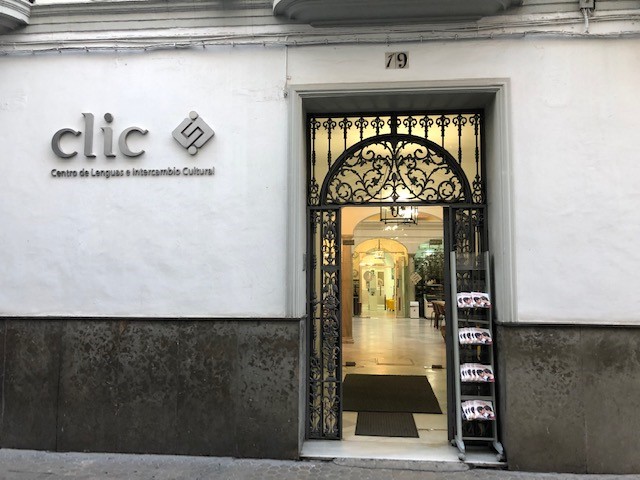
As a tradeoff for quitting a dream job with marvelous colleagues, I set a goal to acquire another skill; learning Spanish.  I found an incredible school in Sevilla.  They teach several different languages and are one of the largest language schools in Andalucía.  Part of a global language school (International House), here in Sevilla, they are called CLIC (www.clic.es).  This school has students from age 17 to 80; and even host a few afternoon classes for young kids.  CLIC is considered to be the most prestigious language school in Spain and has an affiliation with several colleges including Trinity College of London, University of Barcelona, University of Sevilla and University of Cambridge (United Kingdom).  In addition, the United States Military sends their personnel to this school to improve their Spanish.  Every three weeks, a new military crew begins their courses.  As I write this, there is a group of 10 Navy personnel that started their three-week program on Monday. They attend classes 6 hours per day and all cultural activities put on by the school (programs are offered daily).


I signed up for 8 weeks of classes.  Classes are Monday through Friday, 9:15am until 1:00pm.  They have a coffee break for 20 minutes midway through the morning.  The maximum class size is ten.

Prior to my start date, I took a written and oral exam to determine my starting level of knowledge.  I was placed in an A2 level.  Not quite a beginner (A1), but a good place to start as it turned out.  Some of the content would be a review, but soon I would learn new material as well.

I was a bit nervous the first day.  Although I had taken some continuing education classes to receive certifications in the Commercial Real Estate Industry, I hadn’t been to “school” in a long time.  My first two weeks, I was in a class with 9 other students. The teacher was my age; however, the students in my class ranged in age from 17 to 28.  I thought I would feel out of place, but I didn’t at all.  Everyone was super welcoming.

The second two weeks, a few of the slackers in the class were placed into a more beginner level course.  Because these students were younger, I don’t think learning Spanish was a big priority for them versus the more social aspects of living in Sevilla.  Several of the students didn’t bother to show up to class, complete homework assignments or would continuously talk in English/their native language in the classroom. This is a big no-no.  We are only permitted to speak Spanish in class. The students that remained in class are pleasant and extremely hard working.  One is from Belgium, one from Switzerland, one from Germany and one from The Netherlands.  It’s interesting because they cannot speak English, and I cannot speak their native languages – yet we all are able to communicate quite well in Spanish together.

As I write this post, I am through 6 weeks of classes.  I have learned quite a bit in class.  I can read and write pretty well; however, I still find it challenging to understand the locals when they are speaking as quickly as they do.  Sevillanos also have a habit of dropping parts of words and combining separate words into one to facilitate this speed.  Although I’m showing much progress, I just don’t have the confidence to speak at my best level.  I graduated into a B1 level in my 5th week of class.

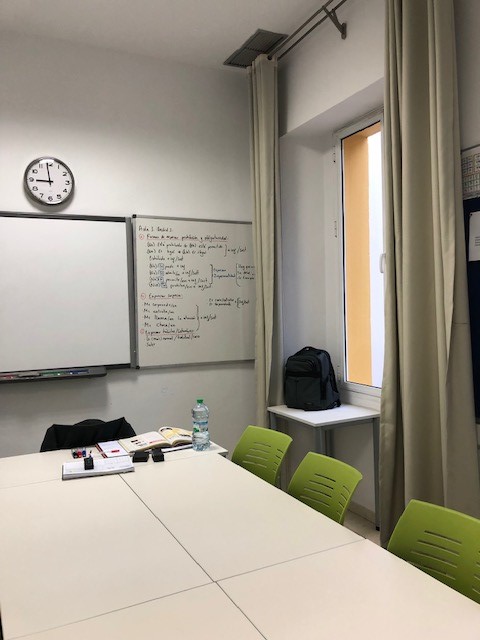
The class structure in general is quite good. We have text books, we watch quick video clips, we listen to audio clips and we have several talking exercises.  One afternoon, we took an excursion to The Triana Market for half of our class to interact with locals and to practice Spanish. The classrooms are well appointed with very modern equipment.  My classroom has a white board that is connected to a computer.  You can write on the board and erase it with a swipe of a button.  It’s much more advanced than what I had in school many years ago.

classroom

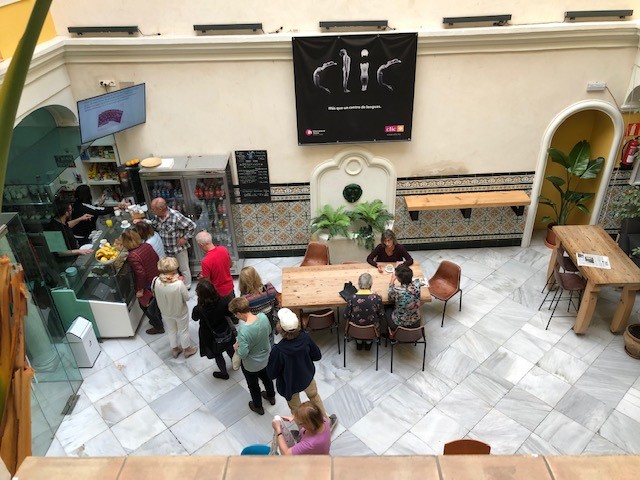
CLIC is a very busy school, with students coming and going every week.  I have had four teachers already in 6 weeks; actually, five teachers as I took a few days of an afternoon class to make up hours missed on a National Holiday and a day of travel to Zurich.  The teachers have all been  professional, friendly but strict, patient and fun.  The first floor interior courtyard was always full of hustle and bustle.

courtyard

As mentioned earlier in this blog post, CLIC offers several extra-curricular activities, scheduled on a weekly basis.  They have free walking tours, day and weekend trips to nearby cities, dinners, museum visits etc.  It is a good opportunity to practice Spanish and get to know your classmates.  100% of these activities are in Spanish only.  One Saturday, we took a day trip to Estepa – a small village in the outskirts of Sevilla.  One evening, I participated in a wine and cheese tasting at a local wine tasting room.

In addition, I found several “Intercambios” to attend.  What is an Intercambio?  It’s a hosted event in a local bar.  Locals and foreign students attend – it’s a mixer for those wanting to practice a new language.  For instance, I went to one last week.  There were about 50 people in attendance from Italy, The United States, Germany, France, Netherlands, etc… along with MANY local people from Sevilla. It’s a friendly setting to have a few cocktails and practice language.  Everyone is truly sweet and patient.  I spoke to a group of people in Spanish for about an hour, and then we switched to English to give everyone their opportunity to practice.  Locals will gently correct you and encourage you to continue practicing.  As a side note, even the locals I see everyday now know to speak Spanish with me, so that I get practice in unscripted situations.

The Spanish spoken in Spain is not typical of the rest of the world.  They have some unique tenses and pronouns not used anywhere else in the world.  Plus, the ever-present lisp and their infamous hatred of the “s” sound (as one Sevillano hilariously told us, why waste the breath on the ‘s’).

I am very grateful we picked Sevilla as our first Spanish speaking city to live during our adventure abroad.  The experience has been exactly as we’d hoped.  The locals here are supremely friendly, willing to assist and have patience while I practice speaking their native tongue.  I am told that Chilean Spanish is a bit easier on the ear and tongue.   I will let you know in a few weeks.

Thanksgiving in Spain

Dinner Menu

Much to our family’s dismay, we haven’t spent one Thanksgiving together with our Bay Area family since we met in December 2013.  This year was no different, as we are still residing in Sevilla.  We found a hosted Thanksgiving dinner for expats through Internations.org and quickly secured spots before it sold out.  Our host, Babette Perez (from Miami, Florida and newly engaged to a Sevillano), put together a fabulous evening.  We would like to thank her for sharing these amazing photos in our post and Jose Luis Bustamante (Busta) and his team at Zarabanda’s for a memorable meal.

Babette Dinner Hostess

Extra credit if you can name how Salemily have spent our first 5 Thanksgivings together.  Extra extra credit if you can do it in order AND match location with year.  The answer will be at the bottom.

Our group of about 30 people had the entire restaurant to ourselves. Zarabanda’s cooked and hosted our Thanksgiving dinner.  We are sorry to hurt any of our family or friend’s feelings from our past Thanksgiving dinners, but this meal was THE BEST Thanksgiving dinner we have ever tasted.  OK – remember, we are in Spain.  Most Spaniards don’t know anything about Thanksgiving.  In fact, E had to explain to her class that same day what Thanksgiving was and how it is typically celebrated.  One of her classmates was confused.  She had thought it was a religious holiday and couldn’t believe people got together and only talked about what they were thankful about.

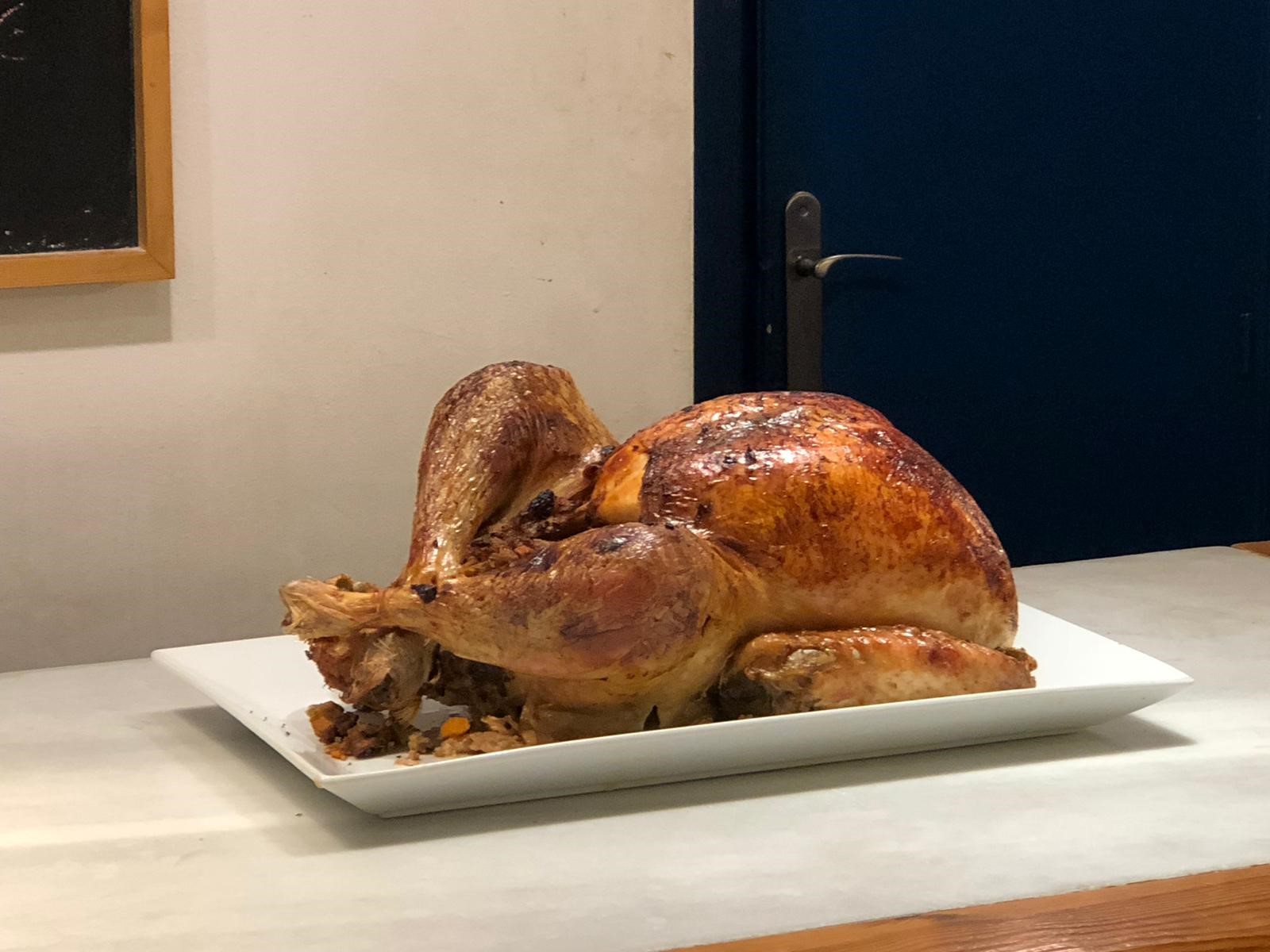
Turkey

The staff at Zarabanda’s had never cooked this type of meal before. Needless to say, we can’t wait to go back to their restaurant and try their daily menu!!!

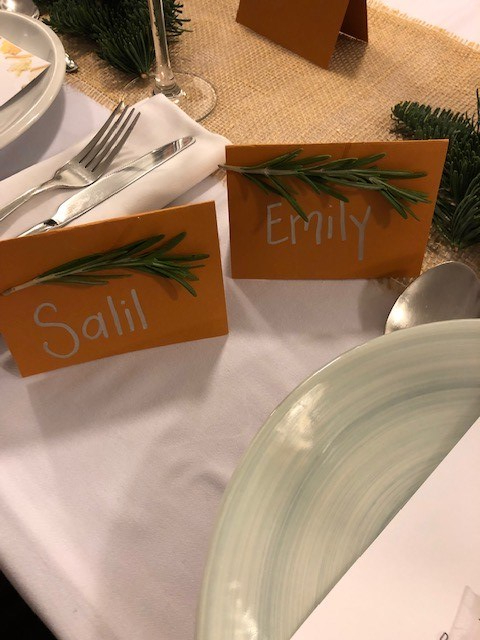
Place Settings

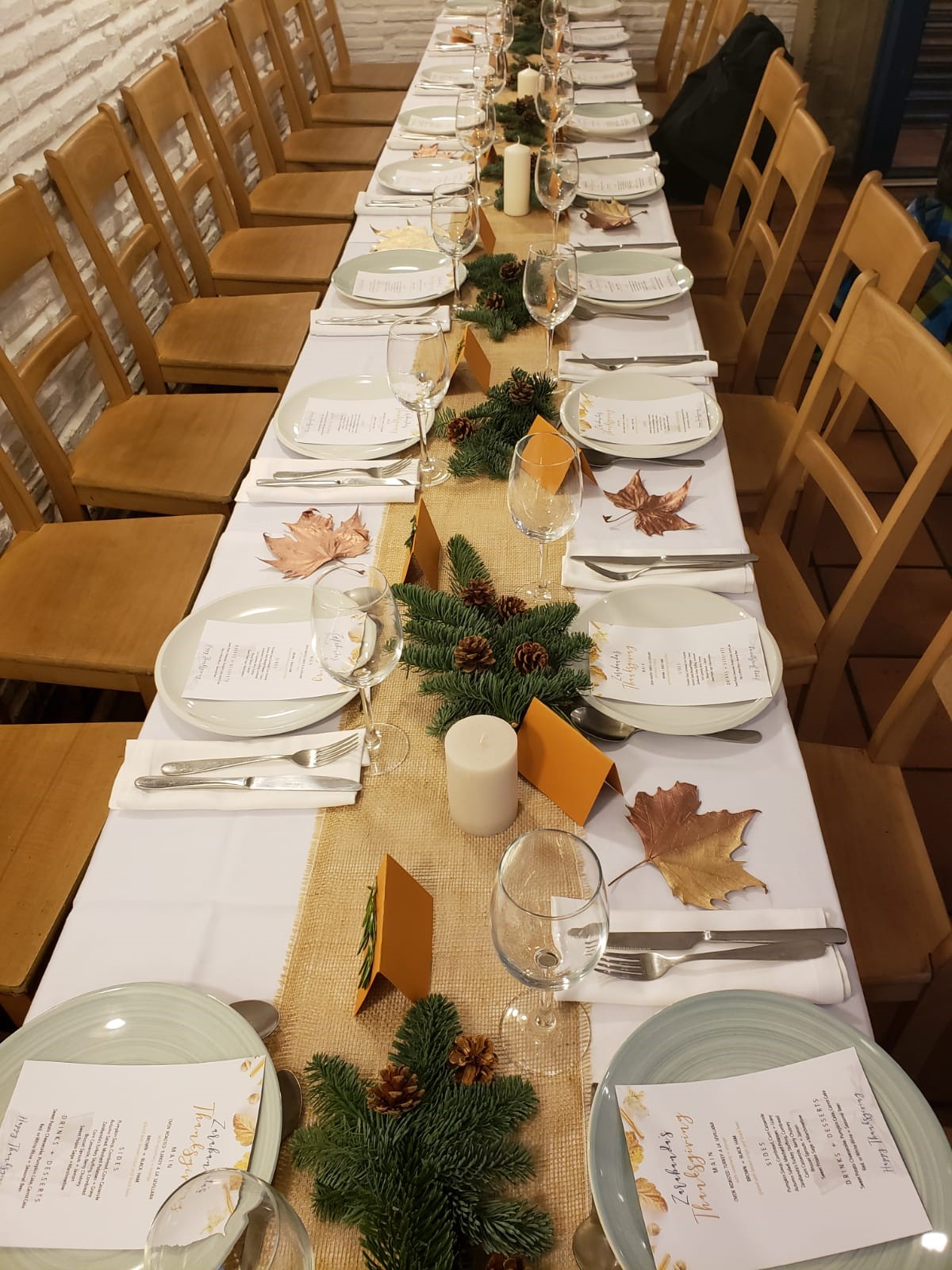
Thanksgiving Dinner Table

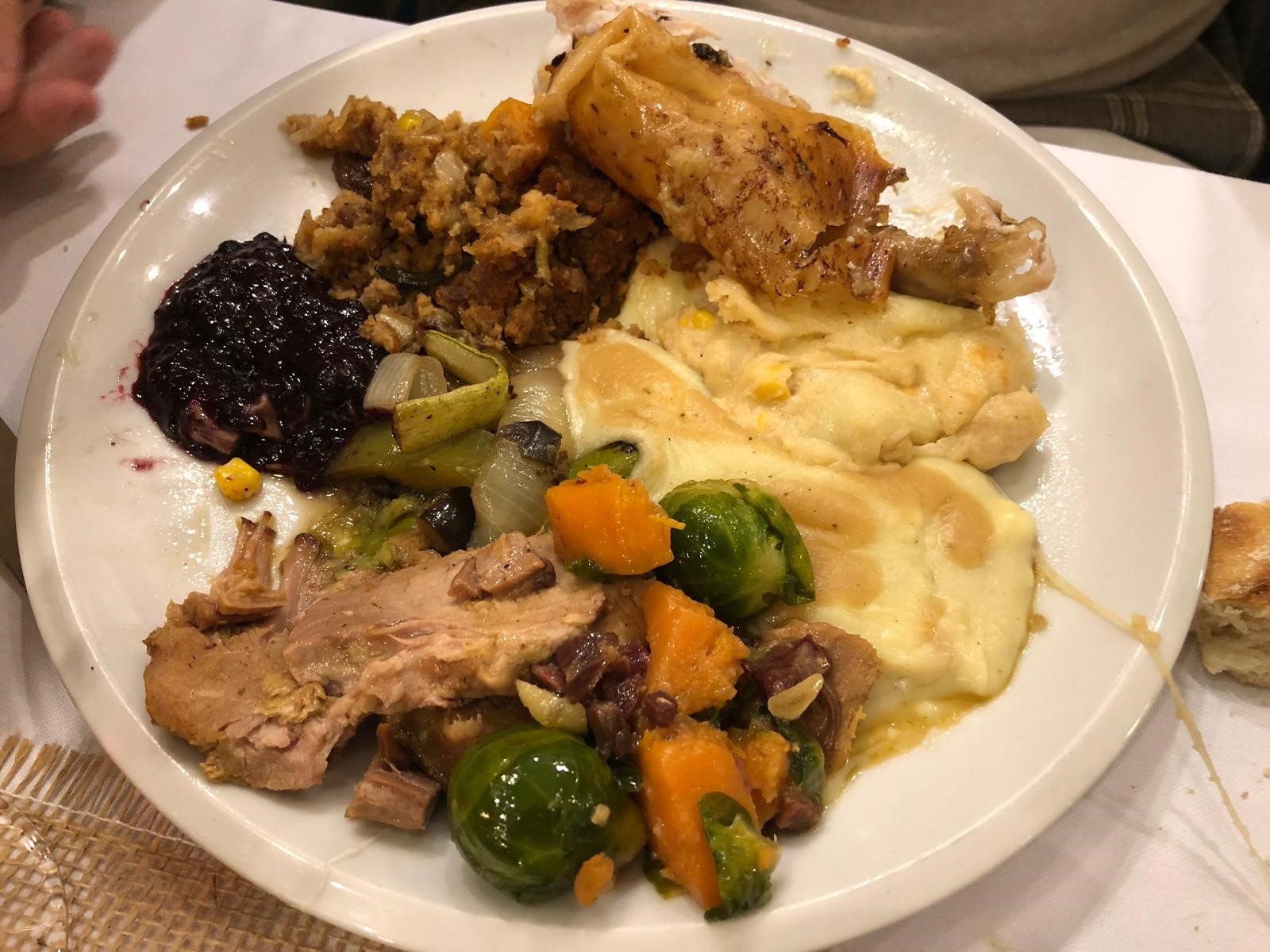
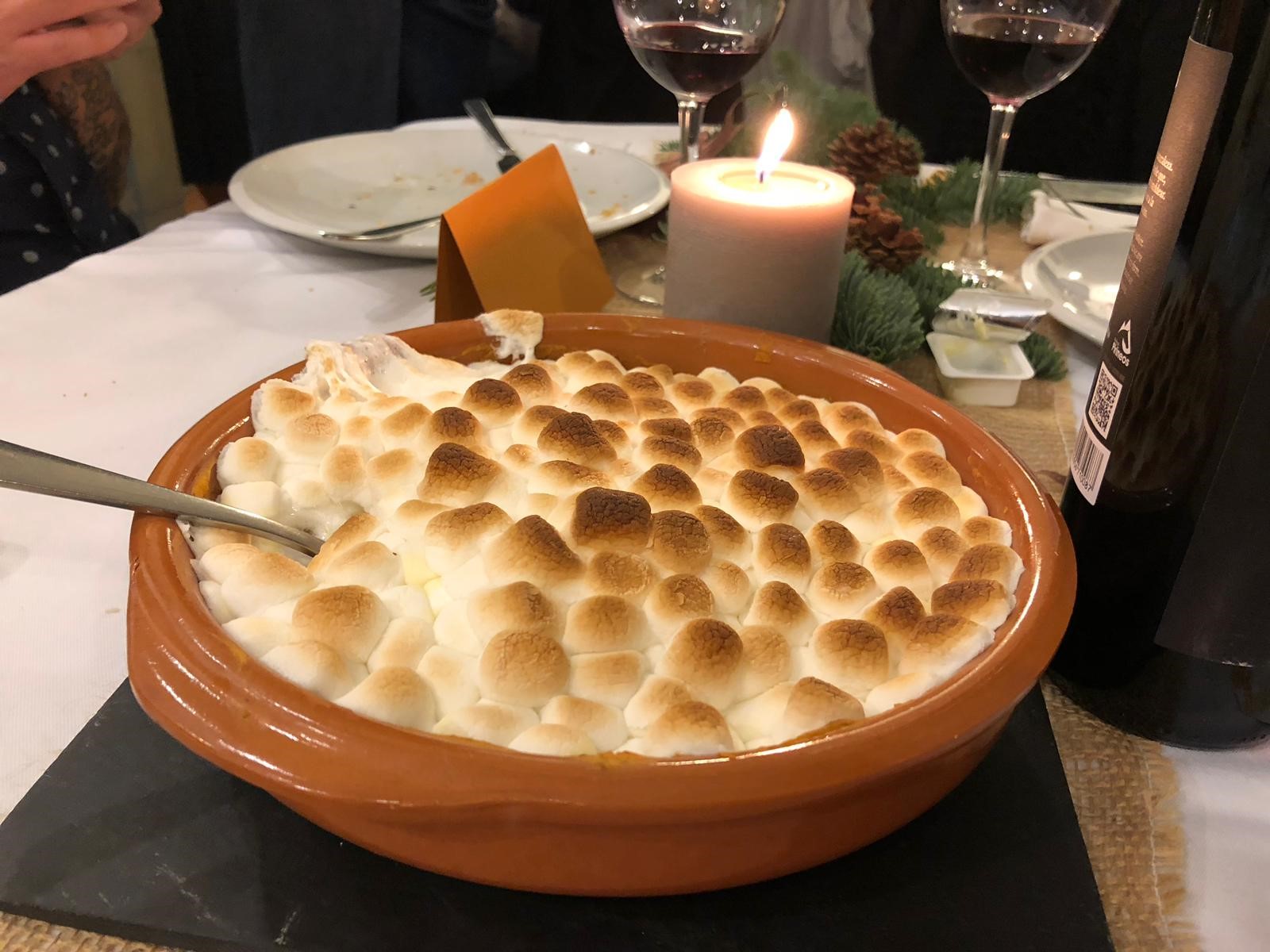
The table was decorated beautifully with place cards for all of us.  Nothing was missing from this meal and everything was made from scratch.  We had cornbread to start, then a delicious pumpkin soup.  Then, we had family style turkey, ham, stuffing, corn casserole, autumn salad, mashed potatoes, berry chutney, sweet potato with marshmallow and Brussel sprouts.  See our menu on a table card up at the top of this post.

Dinner Plate

Marshmallow potatoes

Included with the meal was unlimited wine and beer.  They served a high-quality cabernet blend and a seasonal pumpkin beer.  This quickly got the conversation flowing throughout the room.  We were seated near a woman from New York visiting her cousin (who owned the restaurant), another retired woman from New Jersey who is living in Sevilla taking Spanish lessons.  We had a father and daughter across from us – the daughter is going to college in Barcelona and the two of them are taking a mini trip around Spain.  There were a few military men stationed in town.  Also sitting across from us was a woman from northern Spain who now lives in Sevilla; she decided to sign up and come experience her first Thanksgiving.  We loved seeing a few locals join and experience the joy of this glutinous and uniquely American holiday.

A woman sitting next to us, who was born in Ecuador, and now has dual citizenship in The United States and The United Kingdom described her feelings about Thanksgiving.  She said when she immigrated to the States many years ago, she adopted Thanksgiving right away as her holiday.  She said it touched her to have a holiday that had nothing to do with religion and all to do with surrounding yourself with people you love and care about and sharing a nice meal.  Although we didn’t know anyone beforehand, it felt the same way to us for the evening.

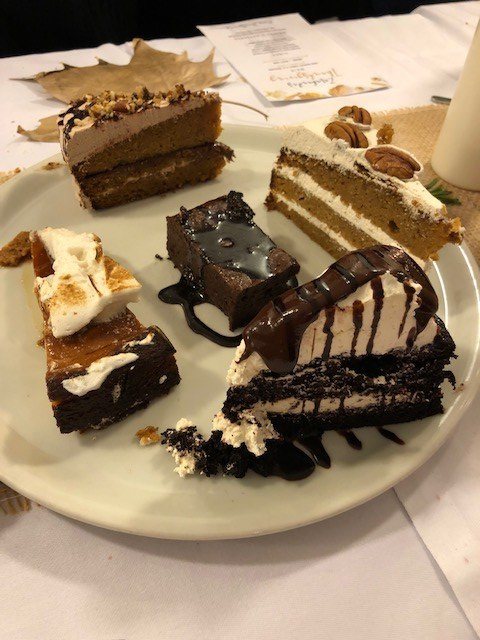
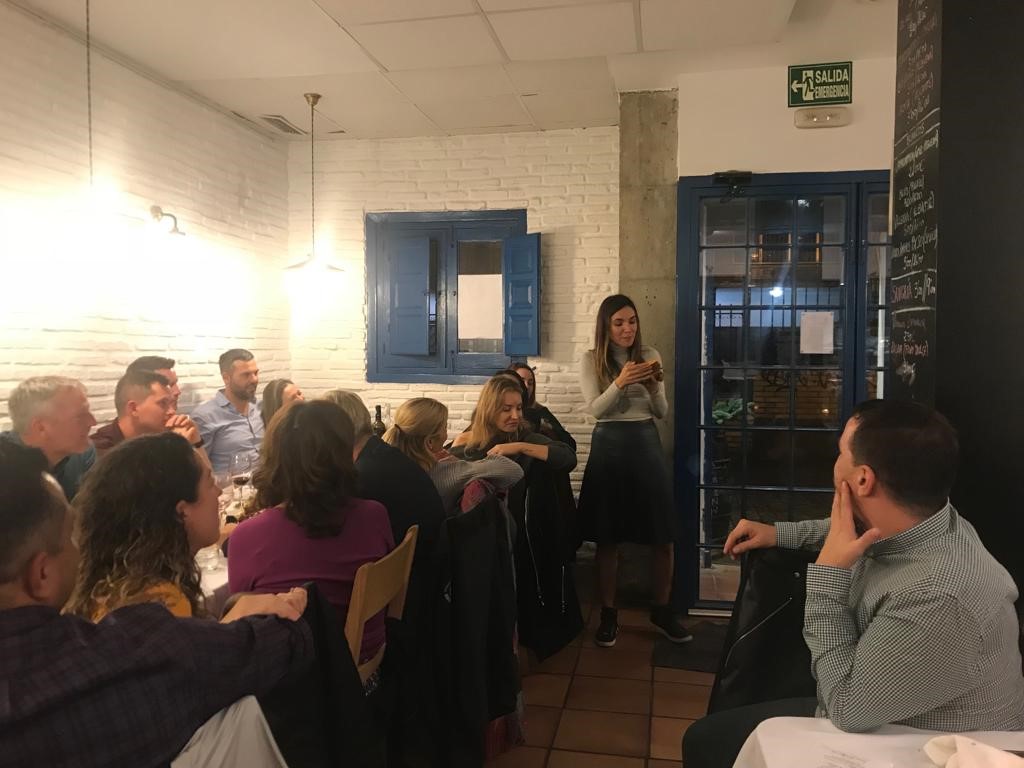
To top off the evening, we were served several decadent desserts.  While we enjoyed every bite of Nutella cake, carrot cake, sweet potato pie, Bailey’s chocolate cake and a chocolate brownie drizzled with more chocolate, Babette began to read out loud each of messages of thanks to parents, family, friends and spouses.  The short stories and thoughts were very touching.

Dessert Photos

Babette Dinner Hostess 2

We are very thankful for having the opportunity to experience the world beyond San Francisco during the first 8 months of our 18 month adventure.  The places have been great, the sites have been awe inspiring and unforgettable, but it’s the been the people that we’ve along the way that have made the trip.  Whether it’s been for just a few minutes, a day or for months at a time, the people have made this trip extra special.  We are thankful for each of these selfless and giving people and for our family and friends supporting us back at home.   Happy Thanksgiving everyone!

2014 = Emily in Antarctica, Salil in the Bay Area
2015 = Sri Lanka
2016 = Madrid, Spain
2017 = Salima, Malawi
2018 = Sevilla, Spain


For more on Babette, see her Instagram page @babetttephotography

For more on Zarabanda, see their Instagram page @zarabandasvq


Running a 5K in Sevilla

Up until now, our posts on wearehere.blog have been written by both of us from our shared perspective.  Putting the WE in wearehere.  None of the posts have been his or hers.  Over the next few days and weeks, you’re going to see some posts written solely by E or written solely by S.  They will be written from our individual perspectives based on experiences that we’ve had in and around Spain.  We mention it only because we’ve been careful to use we or us and now you’re going to see I.  Fear not dear reader.  Salemily is going strong…better than ever.  But some experiences breakdown uniquely E or uniquely S…what follows is the first of these posts and it’s from E.  Enjoy!

While we are living in Sevilla, Spain, our goal is to live just as we would if we were permanent residents.  It was important to me (E) to find and participate in a local running race as part of our experience.  In general, there aren’t many races here during the fall and winter months.  The ones they do offer tend to be smaller, fun runs.  Sevilla is hosting a half marathon in January; however, this will be after we head to Santiago, Chile.  I did find and sign up for a half marathon next April in Santiago with 50,000 of my closets running friends, but I will save that for a future blog post once I conquer that race.

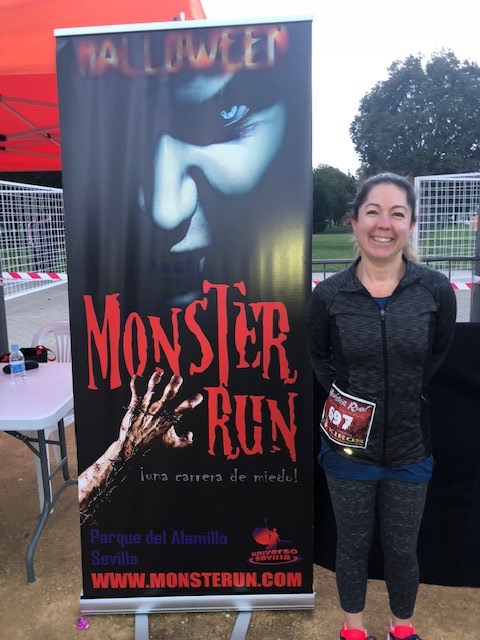
For this post, I found a 5K race in Sevilla with a Halloween theme, called The Monster Run.  It wasn’t going to be a serious run, but at least you would get bibs, it would be on a complete 5K course, and hosted in a large park only two miles away from our apartment.

Emily Fun Run 1

Signing up was challenging.  You have to have a local Spanish resident ID number in order to sign up online.  Luckily, I was able to use the little Spanish I know to email the organizer and find a way around having the ID.  She gave me a number to use, and I successfully signed up.

Fast forward to the night of the race.  As I mentioned, it was a Halloween fun run for all ages.  Given this, there were only about 300 runners, most of which were dressed in costume and full makeup.  I would not want to run over 3 miles with thick white paste on my face, or a heavy costume.  Scattered throughout the celebration area were a few serious runners.  They were easy to spot as they only sported athletic gear and were stretching before the race while the DJ played some dance music in the park.  The organizers even offered a Zumba class as a pre-run warmup.

When it was time to head over to the start line, I was shocked to see spectators and even race participants smoking in the crowd of the start area.  Seriously, I was towards the front of the crowd, at the start line and a woman with a race bib was sucking on her cigarette next to me.  I know a lot of people smoke in Spain, but right before a running race??  Really???

More typical for Spain (and a futbol match) was a song being sung by the crowd just before the race began.

Recognize it?

Emily Fun Run 3

When the countdown ended, and we were permitted to begin the race, the crowd behind me started pushing as if their life depended on it.  I almost got knocked to the ground.  I don’t know where this sense of urgency came from, because once I found my way to the front of the race pack, they disappeared behind me.  There apparently weren’t that many “runners.”   Although a little sense of urgency is present at the beginning of a race in the States, it is minor.  The pushing that took place at this fun run would have been more than sufficient for a disqualification at a more serious run.

The Monster Run 5K was a night race.  It didn’t start until 8:00pm and it was DARK out (well past sunset). I had read online that it was compulsory to have a headlamp to participate; but didn’t want to run with one.  I thought – “doesn’t matter, the park will be sufficiently lit” as previous twilight/night races I had participated in were.  About a half mile into the race, there was a sharp turn into a wooded area of the park on a mulch trail.  I thought “whoops – it’s pretty dark”.  By then, the only runners present around me were an older gentleman and two kids about the age of 8-10.

The trail was only marked by some ribbons tied to trees and a few short cones to indicate it was time to turn onto a different trail.  The little girl running nearby me was dressed as a witch.  She was running a few feet ahead of me, and she would turn around and smile every 30 seconds or so.  I think she was partly afraid and wanted to know someone else was nearby, and partly to encourage both of us to keep going. Otherwise, it was pretty eerie on the trail.

Scattered in the dark woods were several kids and adults dressed as zombies and ghosts.  You couldn’t see any of them, until last minute when they would run out in front of you and sometimes even grab you or spray you with silly string or water.  They also had several sites set up to simulate a haunted forest.  One site had an adult zombie with a chain saw.  The race was well done.  Did I mention it only cost 5 euro to participate?  A race of this caliber in The States would have been at least $30.

I could barely see my feet in front of me.  I was nervous I would trip over a twig and fall or twist my ankle.  I was worried about not seeing the trail and getting lost.  Everyone knows I need a GPS on my forehead to get from point A to point B in the bright light of day.  I don’t have the best sense of direction. There was a man in front of me running at a much faster pace than I normally would have run.  He was my motivation.  I knew if I kept up with him, I would find my way to the finish line.

The finish line came MUCH faster than I anticipated.  Not only was I the first woman to cross the finish line, I discovered that I set a new personal record.  The 5K race only took me about 21 minutes and 30 seconds.  It was a great race, I am only sad that our bibs didn’t have a timing chip on it.  This race was a PR and I will not be able to prove it with any results posted to the web.  A dear friend of mine in Arlington, Virginia with whom I used to always compete would have surely owed me a beer after this race!  To that friend – if you are reading this, I think you owe me a beer!  And to the man I chased for the entire race – well, I owe you a beer!  Thank you for the motivation!

Nuestra Primera Semana en Sevilla

As much as we have cherished being on the road for the past six months, we are suffering from a bit of sensory overload.  We hope that you’d all agree that 5 continents in 6 months requires a change of pace.  We have zero regrets but a little routine sounds pretty good right now.  We’ve visited amazing places, experienced numerous types of cuisines and met incredible people, but we are very excited to have a home base for the next three months.

As part of our eighteen-month adventure, one of our goals has been to experience living as locals abroad.  Due to visa constraints, we have generally only been able to stay put for three months in any given location.  Until now, we’ve compensated by constantly moving.  But it’s time for that to change.  We chose Sevilla for our home base because we wanted a location in Spain but one with a slightly more local feel.  One that didn’t quite have a premium international profile.  We are very happy with our decision and have quickly fallen in love with Sevilla.

What follows is a quick summary of lessons learned from our first week’s experience.  Adapting to our new home and the local customs has been exactly the experience we’d hoped for!!

We hit the ground running, as we always do, and quickly immersed ourselves into this great city.  In our first couple of days, we accomplished a lot:

  • We joined a great gym, less than a 5-minute walk from our apartment. The pricing is much more reasonable than what we paid for gym memberships in San Francisco. Included is an indoor pool, three studios with multiple classes hourly, and a very sizable area of cardio, free weights and other equipment.
  • E signed up for 8 weeks of Spanish classes at a local school. The classes will take place daily on Monday through Friday for four hours per day, beginning on October 15th.
  • S found a wonderful co-working space. We are both spending time here initially until E starts Spanish lessons. This concept is a little newer to the conservative work culture of Sevilla and the city does not have the big players in town yet such as WeWork.  Arcadia Coworking has a very intimate environment with a capacity of about 30 people.  If you ever find yourself in Sevilla and need temporary workspace, visit arcadiacoworking.com.  They will rent a desk or conference room by the hour, day or month.  Discounts are available for longer contract terms.  Victor and Sergio, who run the place, are top notch gentlemen!
  • We have frequented the local grocery markets to stock up on some apartment supplies and food. Sevilla has a fairly typical mix of large format department stores, high end grocery stores complete with gourmet and gluten free sections, convenient bodegas and specialty stores.  Located throughout the city is also a mixture of informal farmers markets and formal street markets.  One of the (flea) markets near our apartment has been continuously running on Thursdays since the 14th Century!  How cool is that!
  • We went shopping for some local clothing and running shoes. Spain is a bit too fashion conscious for our wardrobe staples of hiking pants and water-wicking tops.

Here are a few fun stories and notes about our experience thus far…

Our apartment

E couldn’t have chosen a better location.  We are about a mile north of the “tourist” zone in a cute little neighborhood just west of Alameda de Hercules.  Picture narrow cobblestone roadways with archetypal Spanish architecture.  Lots of traditional courtyards and the ever present blue and gold tile.  The Alameda itself (a very large plaza one block from our apartment) has a plethora of outdoor cafes, bars and restaurants.  Seemingly all the residents from the surrounding neighborhoods gather in the Alameda at night for cocktails and tapas.  And because it’s Spain, school age kids are running around playing soccer and eating dinner until 11pm on school nights.  As a special bonus, our school and co-working space are both about 15-minute walks to the south.  Just as we did in San Francisco, we still commute together and stop for a quick café con leche before separating for the day.

We have a one-bedroom apartment with a large private open-air patio.  The apartment itself is small but laid out efficiently.  The kitchen has a small fridge/freezer, a two-top electric stove, microwave, toaster oven and pots/dishes etc.  We do not have a dishwasher (very typical of Spain) but we are used to hand washing dishes just as we do when at home in San Francisco (though we do have a dishwasher at home).  We have a clothes washer but no dryer (also typical of Spain).  Luckily, we have the large patio and a drying rack we can use.  The building also has a roof terrace with sunset views and clotheslines for drying laundry.  We have air conditioning and heat, although we plan on using the windows and sliding glass door for fresh air as often as possible.

One curious feature of our apartment, and most every building in town, are metal roller shutters, located on the exterior of each window.  To us, they look like apartment armor.  We’re not sure if they’re purely for safety or function as knock out shades.  Every time we leave the apartment, we close them for additional security and keep them open when we’re home.  Despite living in a safe neighborhood, it is common for our neighbors to keep them closed even during the day – presumably to keep out the heat (it has currently been in the mid-nineties during the day).  That said, we’ve adjusted to the routine of constantly opening and closing the shutters.

Because we live off of a very small laneway, trash service isn’t available outside of our building. We take our trash over to The Alameda where the city has provided trash, compost and recycling receptacles.  The receptacles have underground storage areas that can be raised above ground to facilitate removal.  Several times a week, the municipal waste management service stops at each receptacle, raises the entire block of receptacles, clears the underground storage bins and then lowers the receptacles back to the ground.  It’s not pretty but it’s pretty darned efficient.  Plus Sevilla is clean, so the process clearly works.

Dining

You have heard us say we do not get jetlag.  That is true.  However, our fear is that we will leave here in three months and experience “eat lag.”  We’re not sure it exists, but it must.  The dining schedule in Spain is much different than in the States.  Here is a typical schedule in Sevilla:

  • 7 to 9am – Pre-breakfast of coffee and toast at home or on the way to the office
  • 10-11am is breakfast time
  • 2 to 4pm is lunchtime combined with siesta
  • 9pm or later is dinner time. Cocktails and tapas earlier but a proper dinner is generally later.  Some restaurants don’t even open until 8:30pm or later.  Chances are if you see someone eating at 7:30pm, it’s a senior citizen or a young child.  Restaurants don’t get busy til after 10pm.

Locals dine out week nights too – even late at night!  Speaking of dining out, we noticed something small.  Every outdoor table has its own small trash can under or next to it.  Spain has the trash situation figured out quite well.

Bars have coin operated machines with tinned olives or the famed Spanish almonds.  Imagine a gumball machine – filled with tins of olives and almonds!  And not just one kind of olive – every conceivable kind of olive!  It’s not unusual to see 8 or 10 varieties.

Bars stay open late in Sevilla.  A closing time of 3am or 4am is fairly typical here.  We took a train to a nearby city early one Saturday morning and we saw late night revelers still milling about in The Alameda at 6:30am!  Now you know why the apartments have metal roller shutters – they’re also knock out shades!

Shopping

Shopping hours also take some planning and getting used to.  Stores siesta in the afternoons, for multiple hours.  For instance, the running store from which we wanted to purchase shoes is open from 10am til 1:30pm, then again from 6 til 8:45pm.  Every store is different, so you need to research ahead of time – or else one may be disappointed when you are greeted by a “closed” sign in the middle of the day.  MOST everything is closed on Sundays.  These hours require a little more planning than what we are used to.  In the States, a store would go out of business if it wasn’t open on Sundays and holidays.  Spaniards take Sunday very seriously – it is meant for friends and family, religion and rest.  We agree with this concept.

It took us a few minutes to figure out how to shop for produce.  Our local grocery store has two produce sections.  In the organic section, you are not allowed to handle any of the produce.  You ask for assistance and they choose on your behalf and bag it for you.  There is a regular produce section as well.  Here, you choose your items and weigh them at a digital station.  You click on the proper produce number (each section lists the price and number to be typed at the digital scale) and it prints out a sticker with the cost, which should be placed on the sealed produce bag.  We learned this one the hard way when we were at the checkout and the cashier asked us to go take care of this before she could ring up the item.  Thankfully no one was behind us.

Our Fitness Experience

In the States, gyms are generally open from 5am til 11pm.  Some are even open 24 hours, 7 days a week.  We joined a high-quality gym and the hours here are more limited.  Monday through Friday the gym is open from 7:30am til 11pm.  Saturday hours are 8am til 10pm and Sunday features a limited schedule of 9am til 2pm.  This schedule mimics dining and shopping schedules.  Fitness classes are also very limited on Saturdays and there are no Sunday classes available.  We guess fitness instructors need rest and relaxation time too.

As we mentioned, our gym has a large selection of classes and we are taking advantage of them.  It is rather-humorous taking them in Spanish – but so far it has worked out OK.  In Body Pump, it helps to watch the person in front of us.  E is geared up for a Spin class, S is a bit more fearful.

When using cardio equipment, obviously you have to set it up in Spanish and the distance is measured in kilometers.  This requires some quick and continuous calculations when following a fitness routine on our Aaptiv app.

E signed up for a local 5K race.  It isn’t as easy as signing up for one in The States.  You have to have a DNI# (a local ID card) to input while registering online.  We were able to contact the race organizer and explain that we are from out of town, and they gave us a stock number to use. Obviously, these websites are also only in Spanish, so it takes a little longer to translate and navigate as you go.  Plus the pre-race instructions leave quite a bit to be desired.  That said, the race costs €6 per person so it’s far cheaper than in the States.

Medicine

We have great health insurance and prescription insurance; however, it seems we don’t necessarily need it here. Yes, we are keeping it should any major incidents arise!  We had to get more medication for a maintenance prescription we have.  We were wondering if we would have to first make a doctor’s appointment because we only have the prescription a doctor in the United States.  We looked up the equivalent medicine, as some medicines are marketed under different names overseas.  Then we walked into a local pharmacy and not only did we NOT need a prescription, they sold us a one-month supply for €2.81, or $3.24.  The copay alone would have been $10.00 in The States.  This made us seriously question why we have a prescription medicine supplement for our current health insurance policy.  Our blog is not about politics, so we will skip further discussion here.

Small Shopping Errors

Chances are, you won’t live overseas without making a couple of small errors – gringo taxes as we have taken to calling them.  So far, we have taken home two items in error that we otherwise would not have purchased:

  • Hmmmm – this doesn’t quite taste like peanut butter? We were stocking up on a few staples on our first grocery store visit and decided it would be nice to have some crackers and peanut butter for an afternoon snack.  After a visit to the gym, E spread some of the “peanut butter” on her crackers.  Why are the crackers so damned sweet?  After closer observation of the “peanut butter” jar, we figured out the jar contained crunchie cookie spread.  It is called “Biscoff Crunchy” and actually does taste quite good.  At first glance while impulse shopping, it looked like plain old peanut butter.  That said, we were told to try the spread on apple slices and it’s quite delicious.
  • This black pepper isn’t very spicy? We saw a salt and pepper shaker next to each other with other spices and grabbed the pair.  We cooked two meals before we figured out it wasn’t black pepper.  It was black salt (Sal Negro the bottle says)!  That means we were eating double salt (luckily, we hardly salt food) and didn’t quite realize it.  We had never heard of black salt.  It’s even large grained so there’s no reason to think it’s not pepper.  Lesson learned.

If this is all that has happened so far, we are winning!

As we continue to find our way in this city, we will be looking to attend local concerts and festivals, meet people to socialize with and other experiences far beyond touring any of the sites.  We hope to pick up a little of the language, or to at least not be answered in English when we attempt to ask a local a question in Spanish.

Although these are our aspirations while we are living here, we would love to hear any feedback and suggestions from you on Sevilla too!

A Dining MUST in Tangier, Morocco

After eating mostly pastillas and various kinds of tajines for the past two weeks in Morocco, we were ready to expand our palette and try something new for lunch.  After arriving in Tangier by train, we opted for a petit taxi to get to our hotel.  There are two kinds of taxis in Morocco – grand and petit.  Grand taxis are old Mercedes cars – they cost a bit more, have A/C and are hired as needed.  Petit taxis are smaller cars that function a bit more like Uber Pool or Lyft Line.  The driver waits to fill up his taxi before heading off or may pick up a rider or two along the way.  Our petit taxi companion (who also functioned as our translator for our driver) recommended we try a small fish restaurant as it was located near our hotel.

Seafood in a coastal town?  Yes, please!

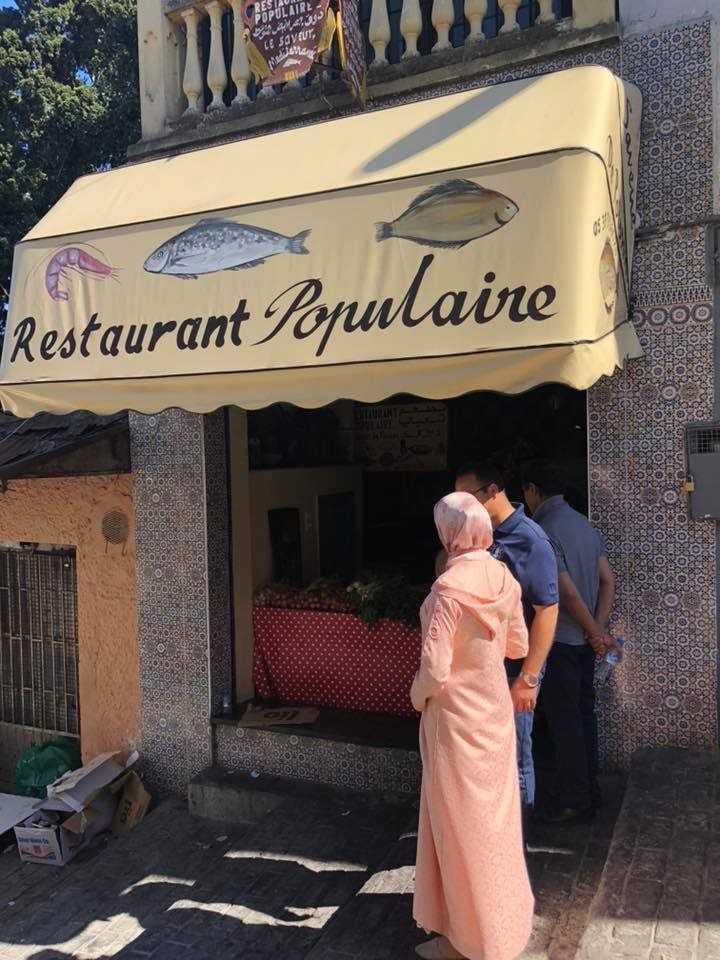
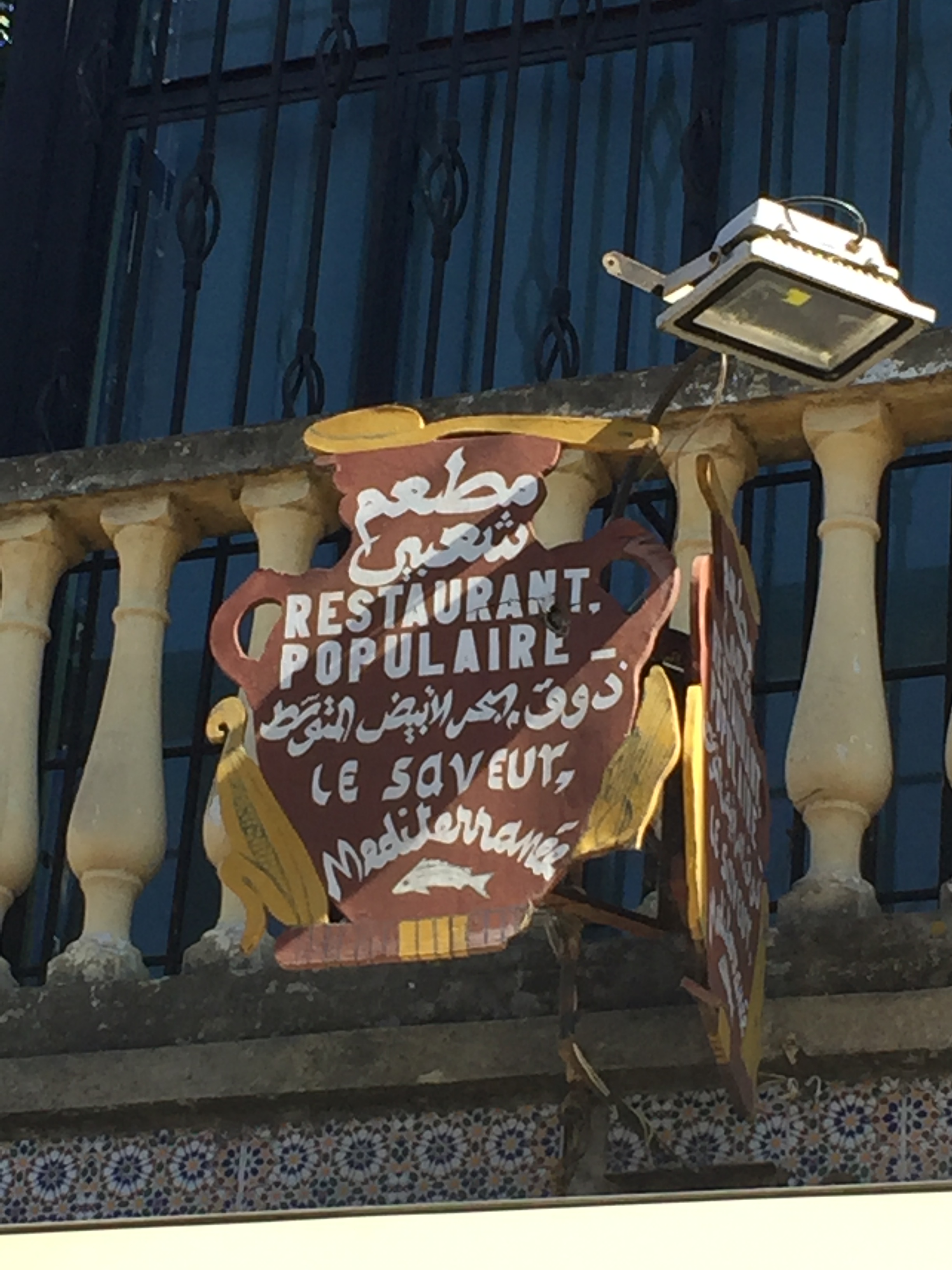
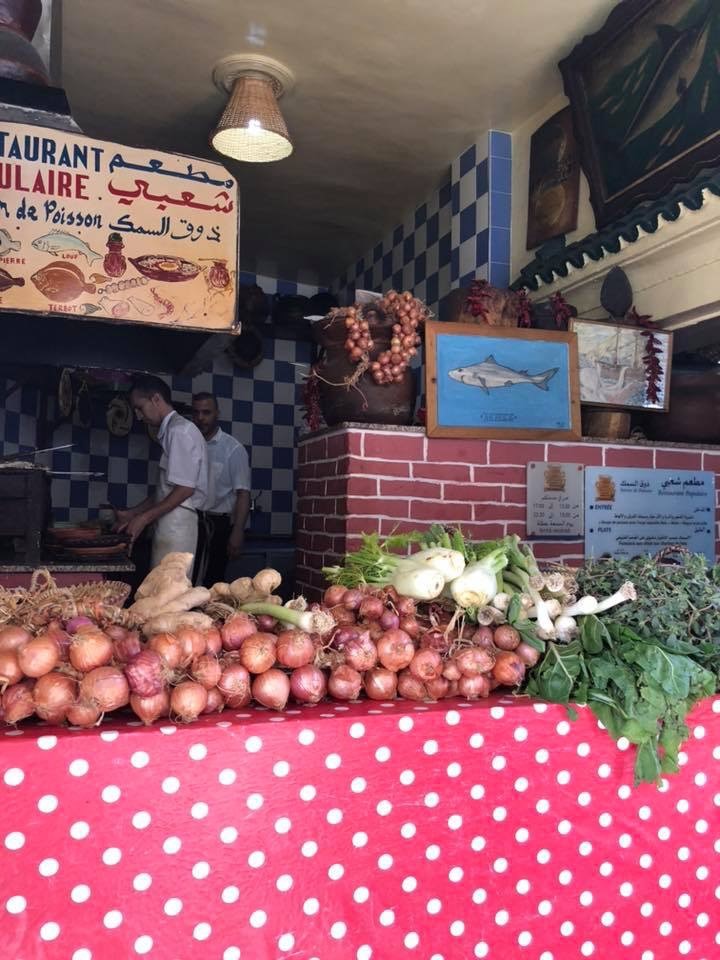
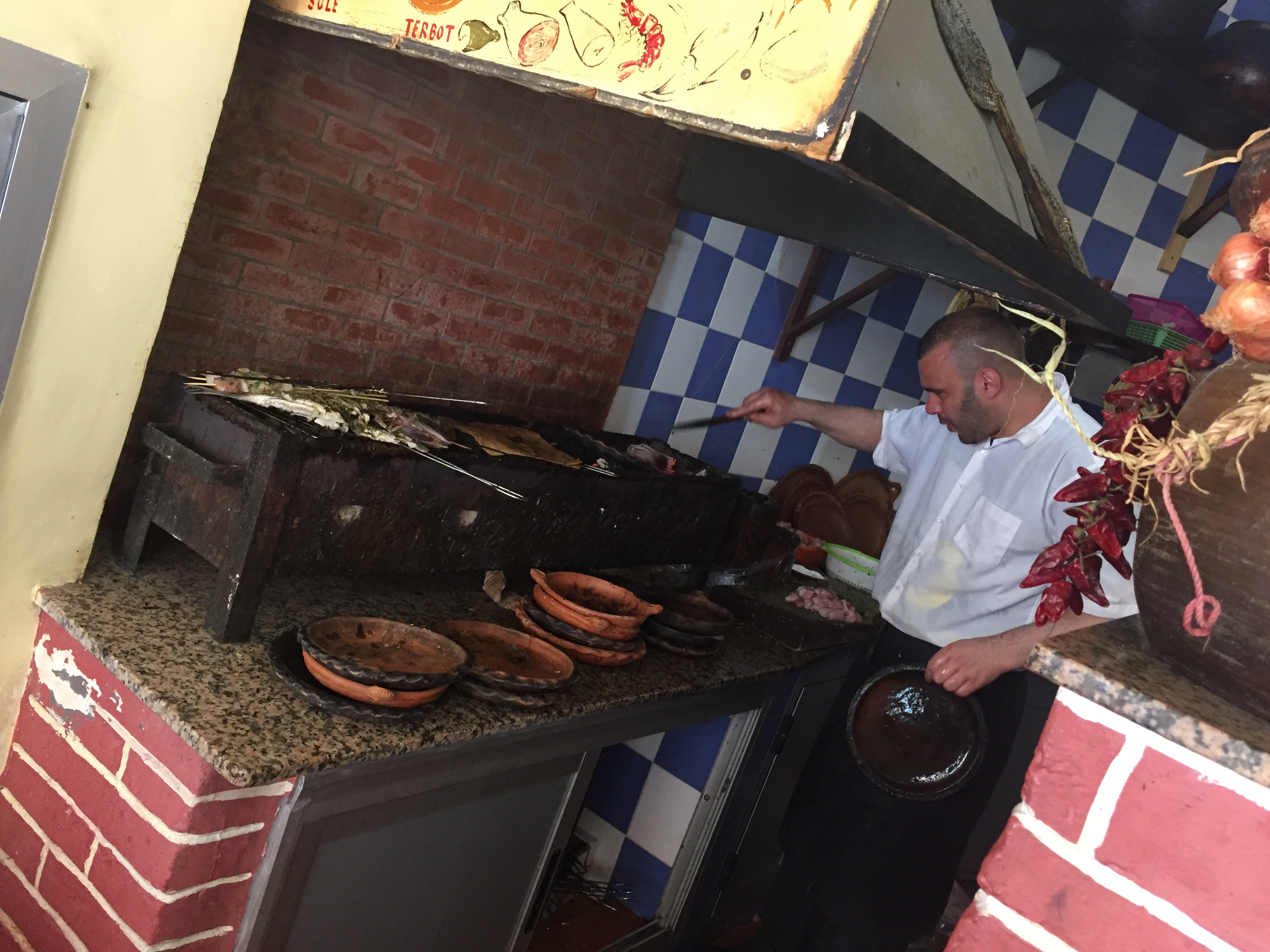
On our second afternoon in Tangier, we made our way to Restaurant Le Saveur De Poisson.  On arrival, you are greeted with a narrow storefront displaying fresh produce, and a tiny open kitchen using a primitive wood/coal fired stove to grill fish.  The small dining area on the right serves about 30 people at a time and it’s seat yourself.  With luck on our side, we scored the last small table.

Restaurant Awning

IMG_3857

Kitchen View

IMG_3853

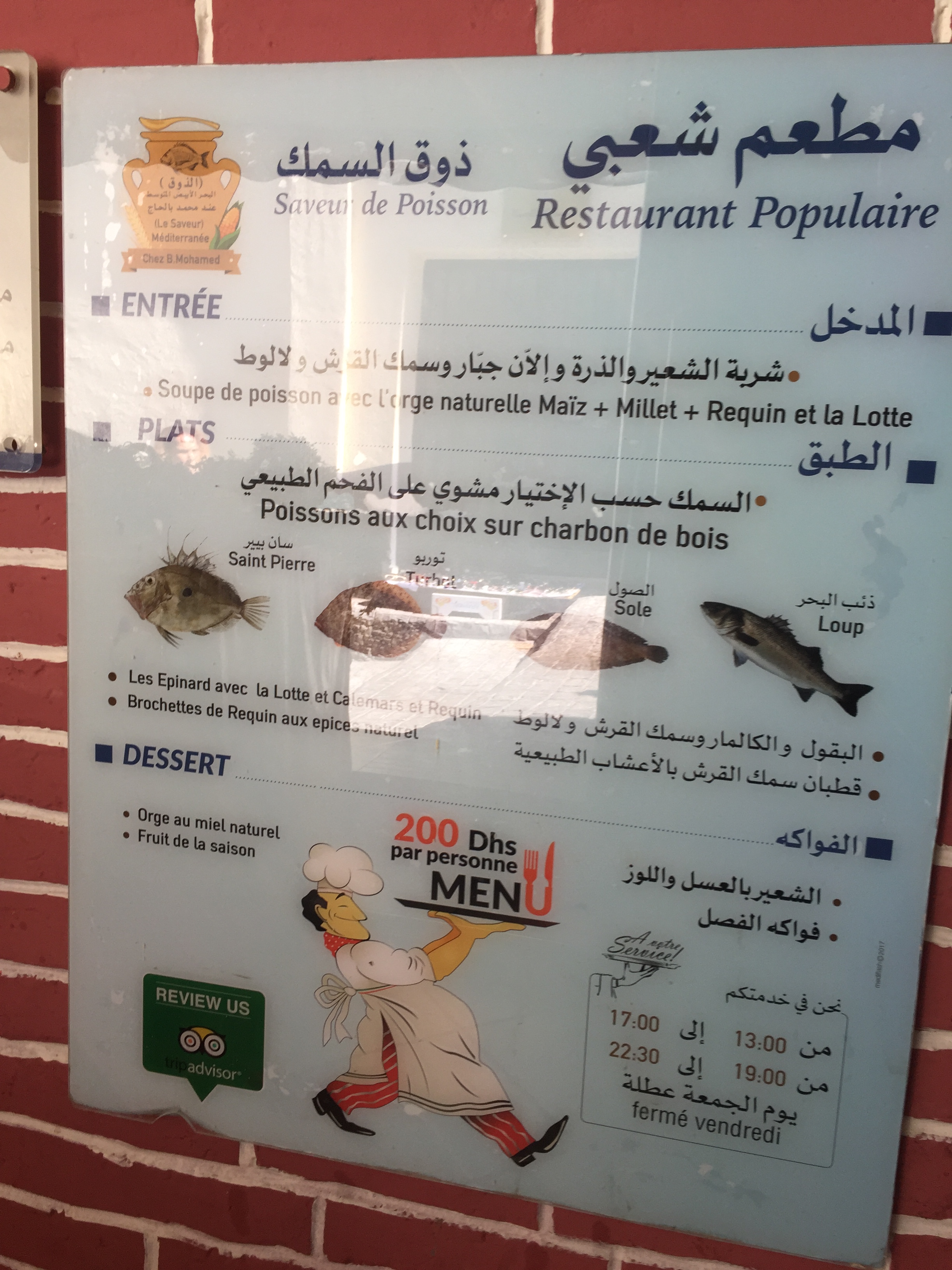
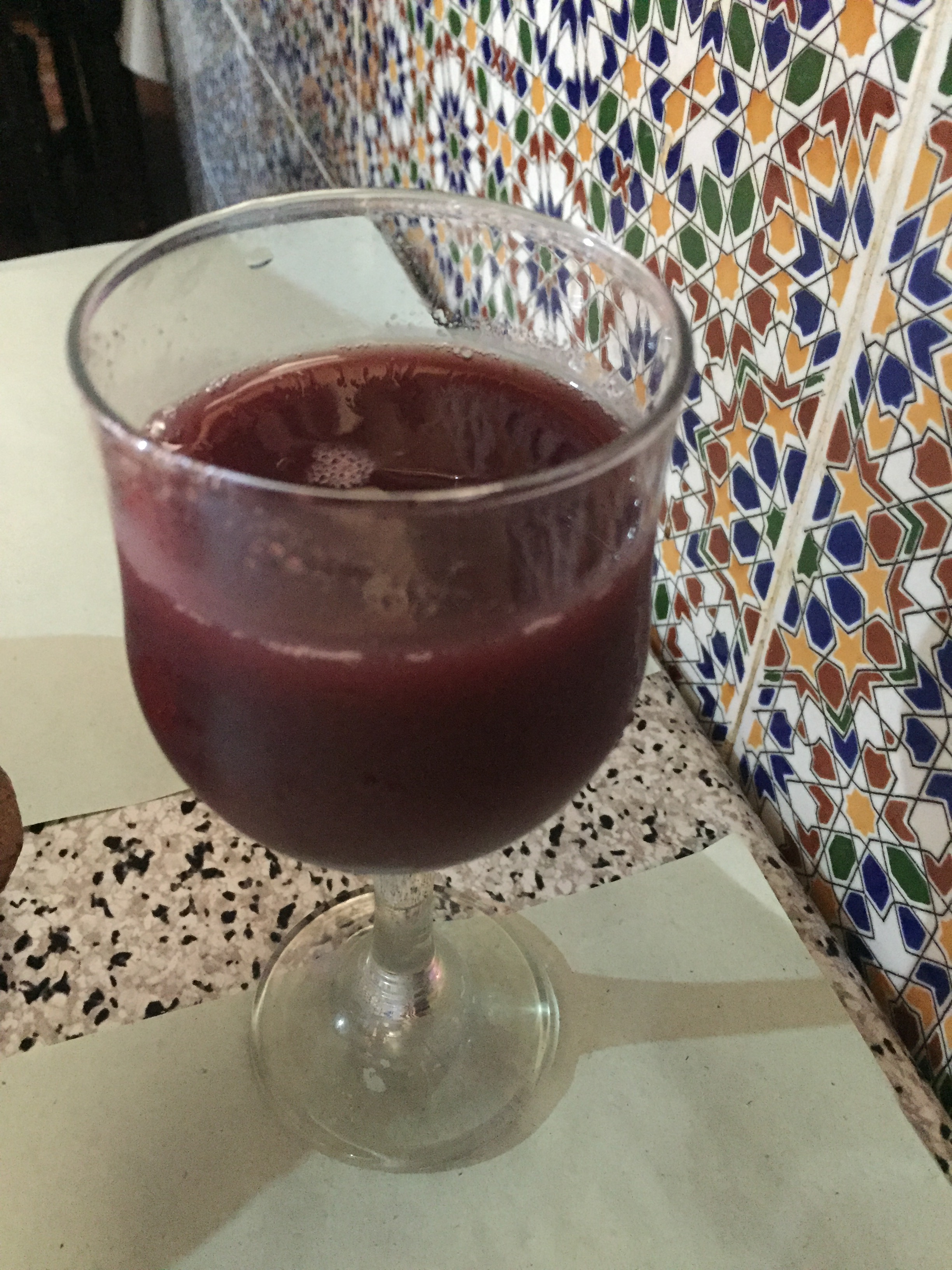
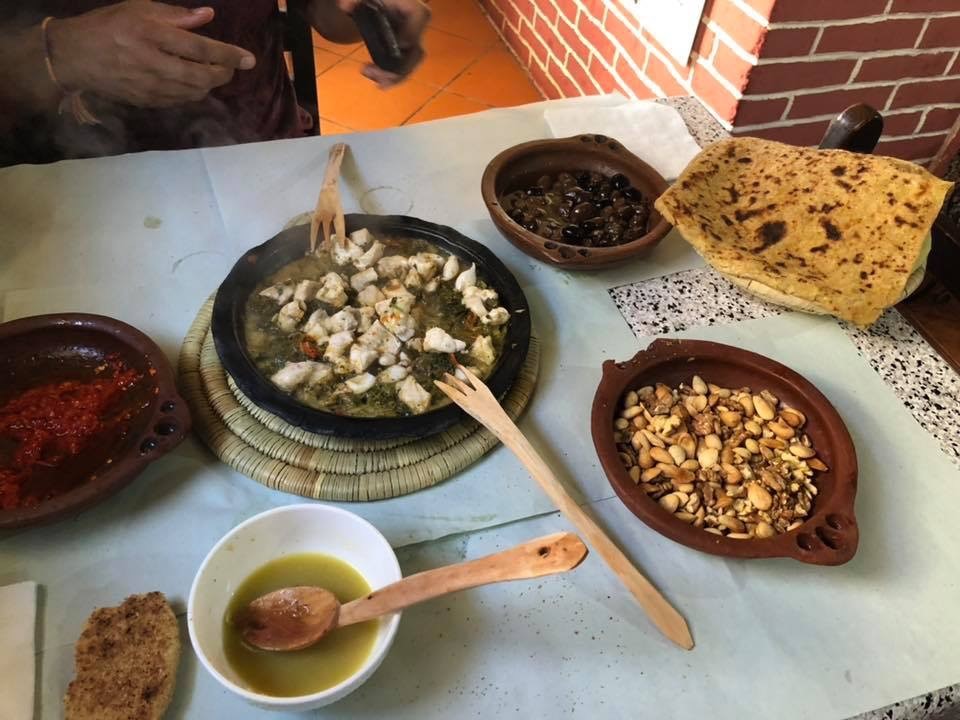
As you enter the restaurant, there is a small sign with the “menu.”  They do not provide a menu at the table as the meal is prepared based on the fresh catch of the day and what’s available at the local farmers’ markets.  Your only role is to sit down and prepare to be amazed.  We were soon approached by a warm and friendly waiter with two glasses of fig and other fruit juice, two bowls of fish soup, a large bowl of nuts and a bowl of fresh baked Moroccan bread with a side dish of fresh harissa.  The dishes are simple and designed to highlight freshness.  Even the cutlery is handmade out of wood.  The portions were large, and we couldn’t stop eating the delicious soup.  Ladies and gentlemen, this was only the beginning.

IMG_3851

IMG_3845

The second course was a dish of grilled baby shark and octopus served on a hot plate.  We’ve never had baby shark before, but it was tender and delicious.  The octopus was perfect…not chewy or rubbery at all.  Just squeeze a little lime and get going.

Full Table

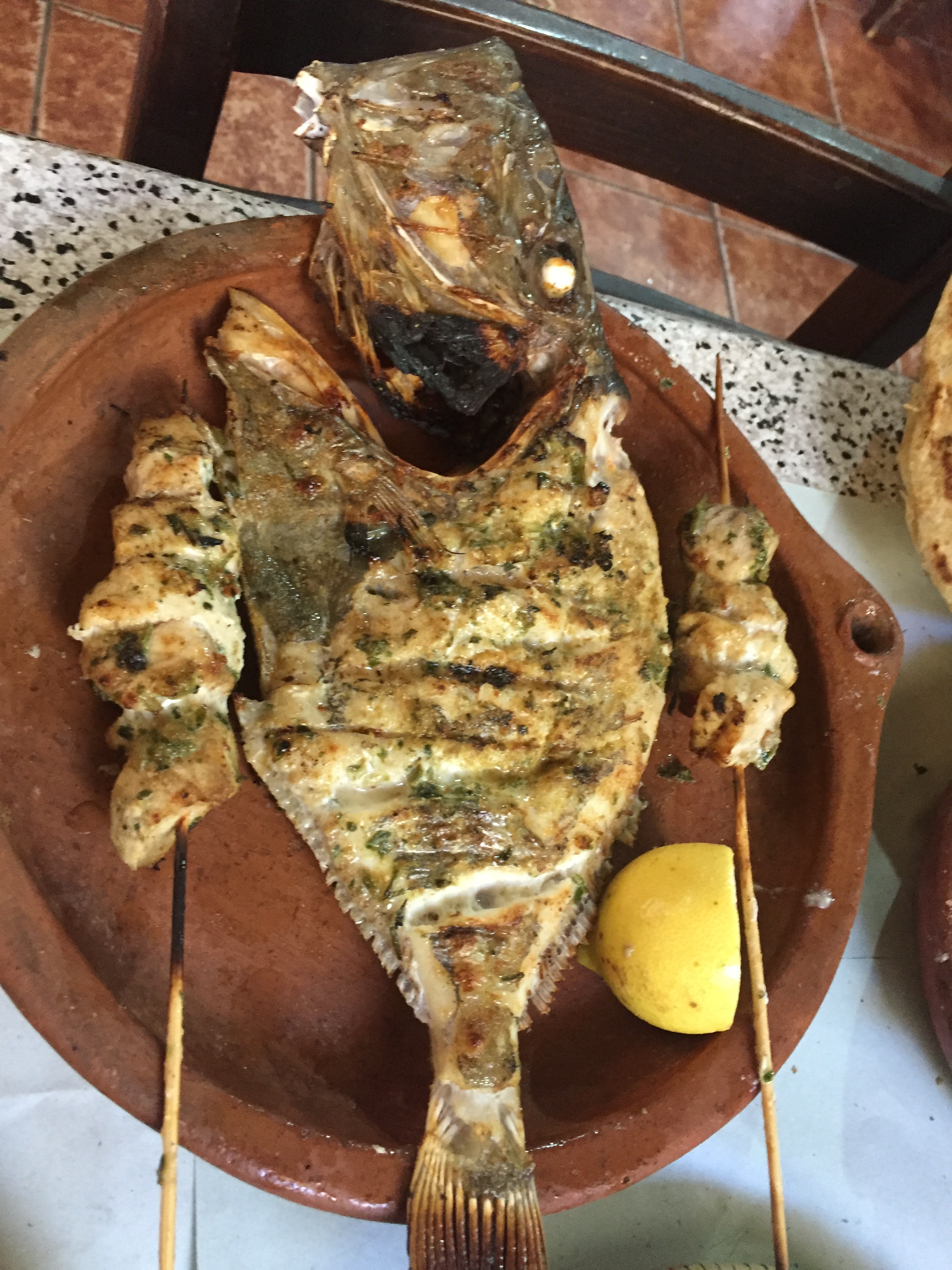
The third course was a whole John Dory fish along with skewers of more baby shark.  Again, squeeze lime, grab some soft bread and enjoy.  Simply divine.

IMG_3848

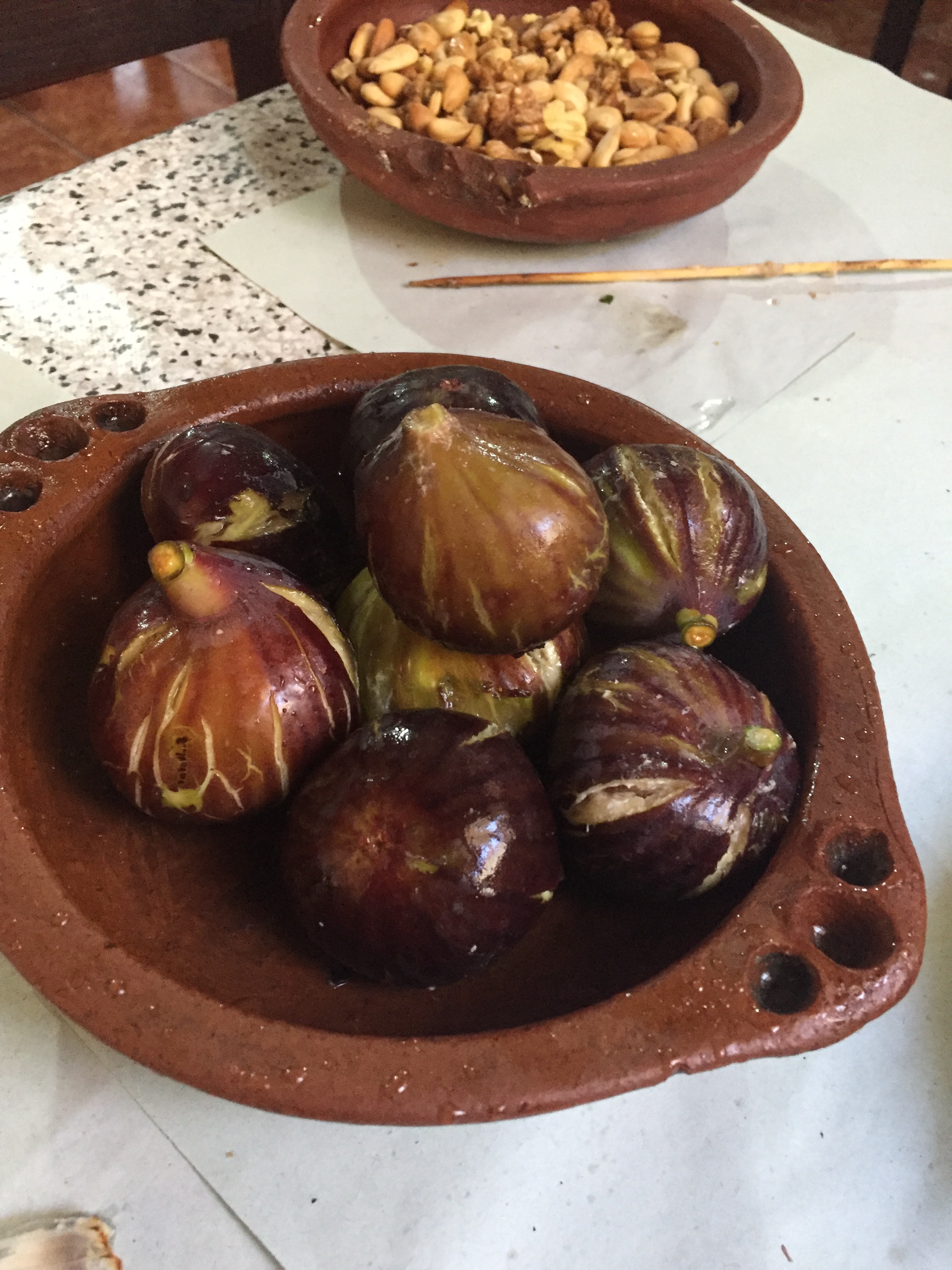
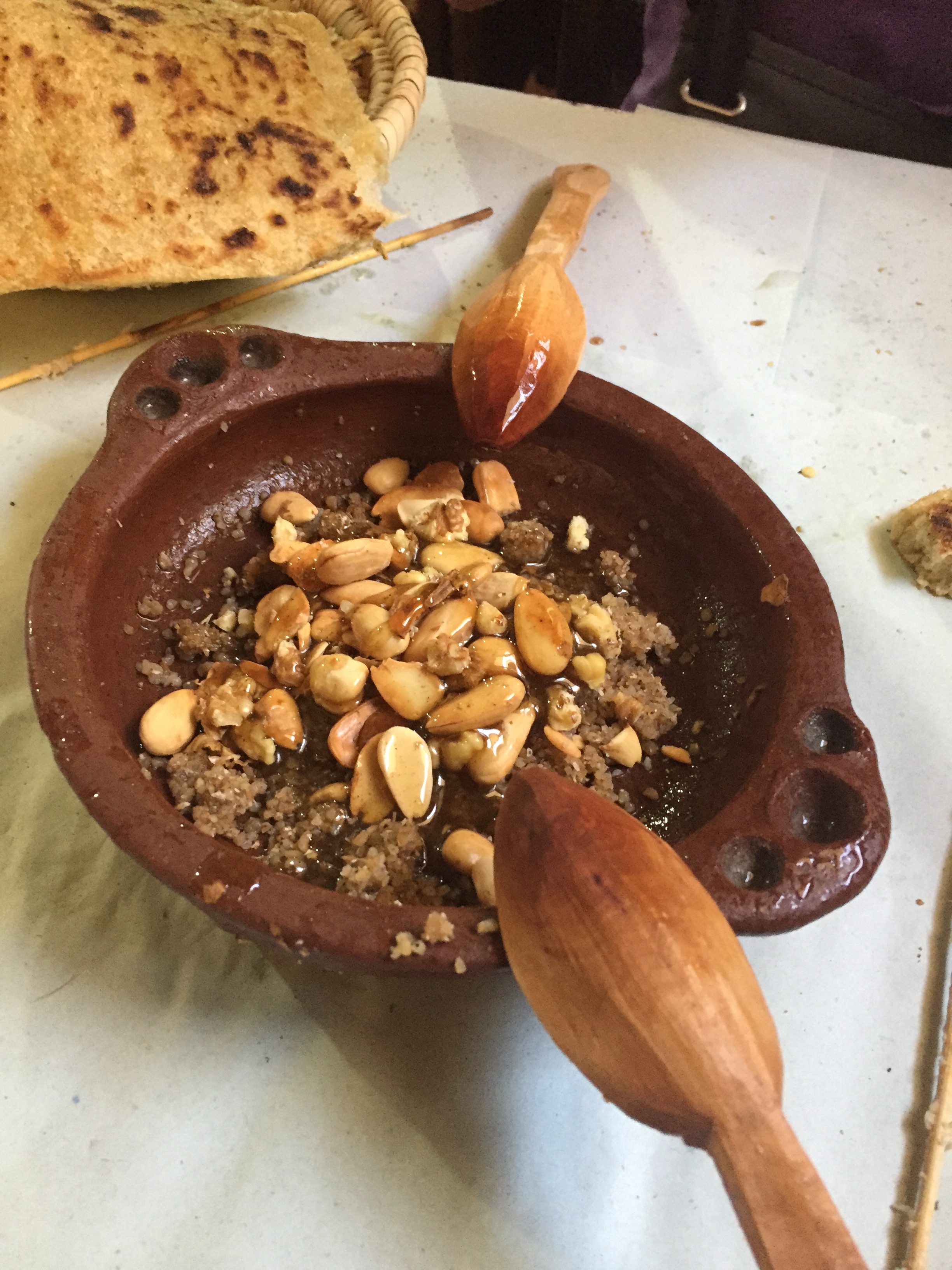
Dessert was a bowl of warm whole figs with warm nuts and barley drizzled with honey.  Nothing complicated but everything worked beautifully together.

IMG_3850

IMG_3849

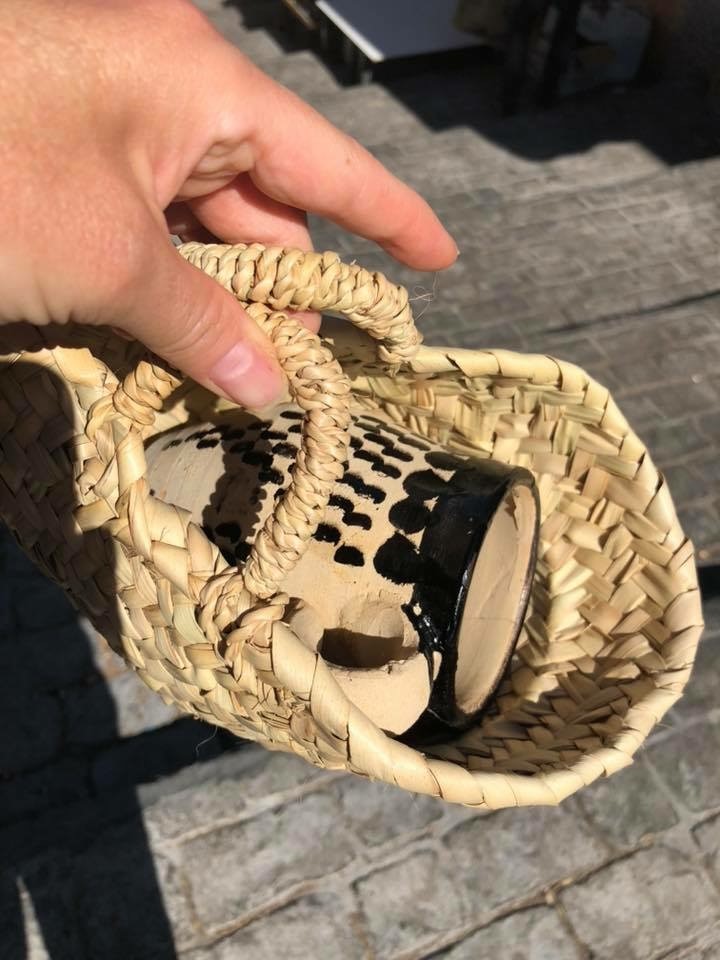
This was the most fantastic and fresh meal we have had in our entire first six months of travel.  How much do you think this meal cost us?  We dread to think how much would it have been in San Francisco?  At about 200 Moroccan Dirhams each (about $20 per person), the meal doesn’t qualify as cheap but seemed a very fair price for such excellent food and service.  Our waiter even included a parting gift of a local handmade mug and a woven basket purse.

Gift basket

We noted in our Bourdain piece that one of his favorite restaurants was Swan Oyster Depot in San Francisco.  It’s one of our favorites too.  We think Bourdain would’ve flipped out over Restaurant Le Saveur De Poisson.  There are many similarities but just enough differences to make the experience unique.  The restaurant is perfect in every way.  It’s not overly fancy.  Doesn’t take itself too seriously.  And the food is the featured star.  The only thing lacking for Bourdain is that they don’t serve alcohol though we don’t think he would’ve minded.  The food is that good.

From our present home in Seville, to get back to Tangier, we’d have to take a train from Seville to San Fernando/Cadiz, a bus to Tarifa and a ferry across the Strait of Gibraltar to Tangier.  Isn’t it absurd to even consider a half day journey with 3 forms of transport to return for just one meal at Restaurant Le Saveur De Poisson?  Hold on, we’re thinking…and checking the calendar…